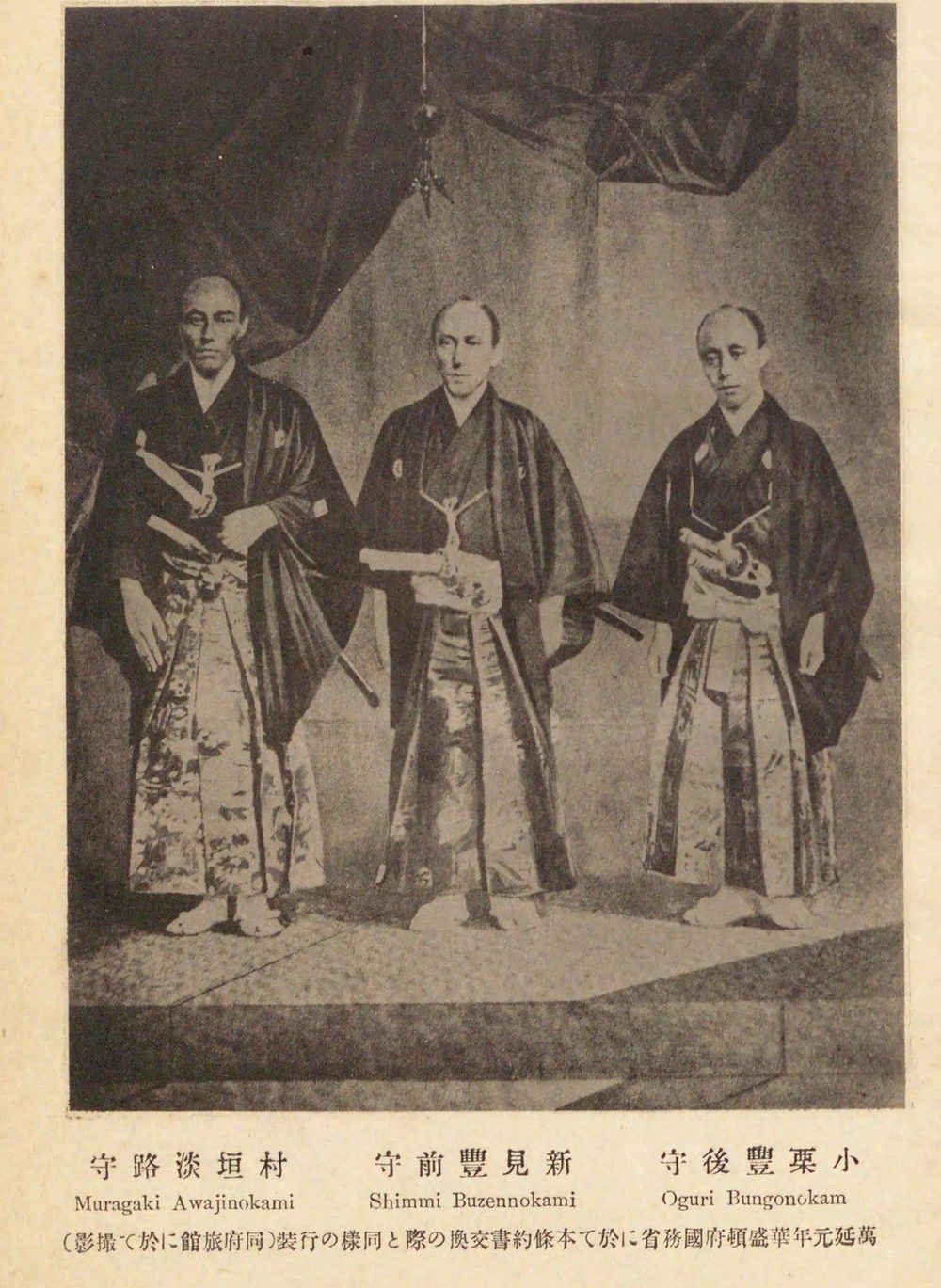
In the ninth month of 1859 Oguri Tadamasa was appointed inspector, and the next day was ordered to accompany the mission going to America to exchange the ratifications of the treaty of amity and commerce. With Shinmi Buzen-no-kami Masaoki as chief envoy and Muragaki Awaji-no-kami Norimasa as vice-envoy, the party numbered seventy-seven. They left Shinagawa in the first month of 1860 and went on to Washington by way of Hawaii, San Francisco and Panama.
Besides the open business of presenting the sovereign's letter and exchanging the ratifications, Oguri had another, heavy charge: the negotiation of the rate of exchange. The affair of the balance at the Philadelphia Mint is the scene from this mission that has been retold most often.
They came home by the Atlantic and the Cape of Good Hope, and so became the first Japanese to travel around the world. This chapter follows in order the year and more from his being chosen to his appointment as commissioner of foreign affairs after the return.
Articles in this chapter
-
How he came to be chosen for the embassy
Ordered to join the mission a single day after becoming inspector. The choice is said to have been Ii Naosuke's; this follows that account, and the adoption arranged before he sailed.
-
Sailing from Shinagawa — seventy-seven men put to sea
On the eighteenth day of the first month of 1860 the chief envoy, the vice-envoy, the inspector and the rest, seventy-seven in all, went aboard the Powhatan. The escort ship Kanrin Maru and her part in the voyage are set out as well.
-
Testing the “myth” of the Kanrin Maru
How far is it right to picture the embassy as the Kanrin Maru? The record is checked here: the main party travelled in the Powhatan.
-
A courtesy visit to the Kingdom of Hawaii
They put in on the fourteenth day of the second month at the Kingdom of Hawaii, an independent country at that time. An audience with the king and queen was something no Japanese had done before.
-
They landed at San Francisco on the ninth day of the third month to a great welcome. Carpets and champagne astonished them, and they went to see the mint as well.
-
Crossing the Isthmus of Panama by rail
To reach the Atlantic side they crossed the Isthmus of Panama behind a steam locomotive. It is one of the earliest records of Japanese travelling officially by rail.
-
The audience with the President at Washington
On the seventeenth day of the fifth month they presented their sovereign's letter to President Buchanan at the White House. A story is also told of their surprise at how small his guard was.
-
The currency negotiation, and the balance at the Philadelphia Mint
The secret charge laid on Oguri: the negotiation of the rate of exchange. He put Japanese and American gold coin on the balance and argued from current value, not metal content.
-
A great welcome at New York, and the “Tommy Polka”
A military parade and a grand ball and dinner. How popular the attendant Tateishi Onojirō became, and the tunes and verses written about him.
-
Tommy the attendant: his popularity, and a false report
A remark about Tateishi Onojirō, by then a favourite, was misunderstood, and a report spread that he had cut his belly. What came of it.
-
“The ablest Japanese of them all”, as Americans saw him
Judgments of Oguri said to survive in American newspapers and in the diaries of the officers who accompanied the party.
-
Home by the Atlantic and the Cape of Good Hope
Home by way of the Atlantic, the Cape of Good Hope, Java, Hong Kong and Taiwan. The mission thus became the first Japanese to travel around the world.
-
Coming home without knowing of the killing at the Sakurada Gate
The killing outside the Sakurada Gate had taken place while they were away. The party came home not yet knowing of it, and is said to have been met in silence.