Besides the open charge of exchanging the ratifications, Oguri had another, quite definite task: to negotiate the rate of exchange between Japanese and American currency. His title in the embassy was inspector. The American papers rendered it “censor”, though at first it was translated as “spy”, and there was a fuss about an embassy with a spy openly among its members. It was this “Oguro Bungo no Kami” who went into the first serious negotiation over exchange rates between Japan and the United States, at Philadelphia.
Why a negotiation was needed — the gap in the gold and silver ratio
Gold was flowing out of Japan in quantity at the time. Abroad, gold stood to silver at one to fifteen. In Japan the ratio had been one to fourteen in the early Edo period, but during the years of seclusion it moved without reference to rates abroad, and by the last years of the shogunate it stood at one to six. With the opening of the country, that gap turned straight into loss.
Harris had had it settled that Japan's ichibu-gin and the American silver dollar should be exchanged at equal weight. The result was one silver dollar to three ichibu-gin. Three ichibu-gin changed for one koban of a ryō; carry that koban back to America and change it for silver, and it became three silver dollars. Silver brought in trebled itself with no effort at all.
As good as the discovery of a new gold mine given by heaven … a crowd of fanatics chasing gold
Alcock, his narrative of three years' residence in Japan (quoted in Sakamoto Fujiyoshi, Oguri Kōzukenosuke no Shōgai)
Estimates of the gold that flowed out differ: the lowest put it at five hundred thousand ryō, the highest at ten million — ten thousand chests of a thousand ryō each. If it went on, the Japanese economy might go bankrupt. Oguri was the man who faced it head on.
A first look at the San Francisco mint
Oguri moved quickly. On 30 March 1860, the day after reaching San Francisco — the ninth day of the third month by the Japanese calendar — he sent off several letters to Japan urging that the outflow of gold be stopped. Four days later, between the welcoming engagements, he visited the San Francisco branch of the United States Mint. Masuzu Shunjirō's diary records his admiration for the speed of the machine that struck silver and copper coins, which finished as many as seventy-two a minute, and the entry for the sixteenth day of the third month in the Akō Nikki of Morita Kiyoyuki, head of a finance group, sets down the place, the kinds of coin and the stages of manufacture, and ends thus.
This treasury office — the coin manufactory — spends no manpower at all, but uses steam machines; water is drawn up to the second, third and fourth storeys by a leather pump, and whenever fire is needed it is all taken from gas. Its convenience and speed are beyond description.
Morita Kiyoyuki, Akō Nikki
The balance at the Philadelphia Mint
Once the ratifications had been exchanged at the State Department on 22 May, Oguri left the ceremonial calls and the sightseeing so far as he could to the chief envoy Shinmi and the vice-envoy Muragaki, and took up the currency question. The negotiation began on 24 May, the fourth day of the fourth month by the Japanese calendar, with talks at Washington with Secretary of State Cass, and then moved to the mint at Philadelphia. What Oguri had brought from Japan was three koban and one balance.
The Japanese censor, Oguro Bungo no Kami, produced a “balance” as soon as the meeting began
It gave us a shock to see it. The part that is made of iron in our country is made of ivory in Japan. A fine scale is cut along about a foot of it, with pans and weights. On test it kept its accuracy without being a fraction out
The Philadelphia Inquirer, 15 June 1860, and other papers
While the American engineers worked at their calculations with sweat on their brows, the Japanese flicked the beads of an “abacus” — fifteen rows of wooden beads, five to a row — had the answer in a moment, and waited, smoking their pipes and smiling. The answers were exact. One paper went so far as to write that “it appears the Japanese system of weights is decimal; the Japanese may be far more rational and advanced than the Americans”. As Sakamoto Fujiyoshi notes, though, Japan's units of money ran one ryō to four bu and sixteen shu, by fours, so this was giving them too much credit.
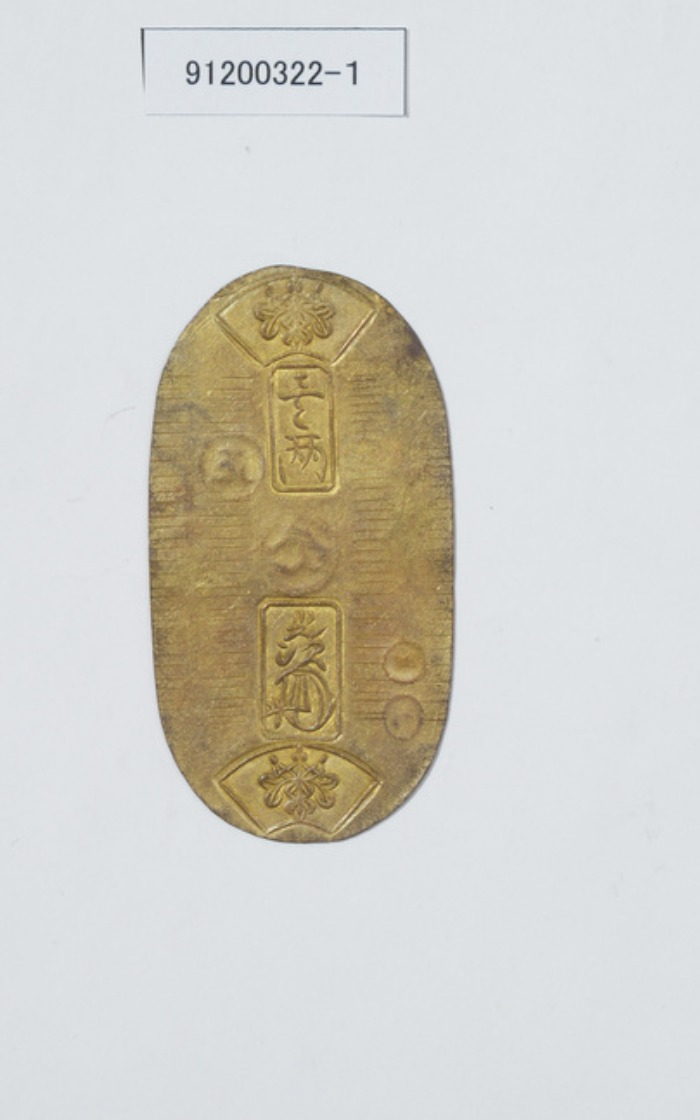
The joint assay
What the test came down to was establishing how much gold the American gold dollar and the Japanese koban each contained. The papers of the day reported the second day of it like this.
Three koban were each weighed whole, then the gold was extracted from them, and finally the koban were weighed again with the gold taken out. All three koban were of equal weight, and the purity of the gold was perfectly uniform
The test ran far past its allotted time, at Oguri's insistence. It was still unfinished the next day, and the Americans had no choice but to have meals brought from the hotel to the mint. With food in them, Oguri and his men only grew livelier and shut themselves in a room of the mint to go at the test single-mindedly — so the papers wrote, half in exasperation.
The embassy was not of one mind within. Morita Kiyoyuki, Oguri's right hand and his man for finance, opposed negotiating in America at all: talks between the shogunate and Harris were going on in Edo, and the embassy had no formal order from the shogunate to negotiate. It was precisely because Harris's high-handedness was producing an unjust result in the talks at Edo, Oguri argued, that the facts should be put in America itself and a negotiation conducted on reasoned, scientific and objective grounds. To those who objected he said flatly:
The responsibility will not fall on you. I take all of it on myself alone.
The mint director's banquet, and the report written on the voyage home
When the test was over a banquet was held, and James Ross Snowden, director of the United States Mint, made a long speech. It was Oguri who rose to answer for the Japanese.
Oguro expressed his thanks for the many kindnesses shown by the officers of the United States Mint, and said that the Japanese side too was glad a satisfactory result had been reached. He said further that he would lay the conclusions of this joint assay and conference before the Japanese government as soon as he returned, and declared that a new system of exchange rates would in consequence be concluded between Japan and the United States
An American newspaper of the time (quoted in Sakamoto Fujiyoshi, Oguri Kōzukenosuke no Shōgai)
The papers wrote too that “the settlement of this most tangled question — the determination of currency exchange and the rate between the United States of America and the Empire of Japan — was the chief object of the present Japanese embassy”. Oguri did not stop working on the voyage home either: in four and a half months aboard the Niagara he put together a long report on the exchange negotiation and the currency question.
There had been talks about the rate of exchange more than once since Perry's arrival. But the first serious negotiation conducted on scientific grounds begins with this Philadelphia conference, Sakamoto Fujiyoshi writes. Abe Dōzan likewise counted among Oguri's achievements that he “fixed his attention on the gold and silver rates at home and abroad, raised the fineness of our koban threefold, and stopped the outflow of Japanese coin abroad”.
Sources: Sakamoto Fujiyoshi, Oguri Kōzukenosuke no Shōgai (the life of Oguri Kōzukenosuke), Kōdansha, 1987; Abe Dōzan, Kaigun no Senkusha Oguri Kōzukenosuke Seiden (a true life of Oguri Kōzukenosuke, pioneer of the navy), Kaigun Yūshūkai, 1941
→ “The ablest Japanese of them all”, as Americans saw him → A great welcome at New York, and the “Tommy Polka”