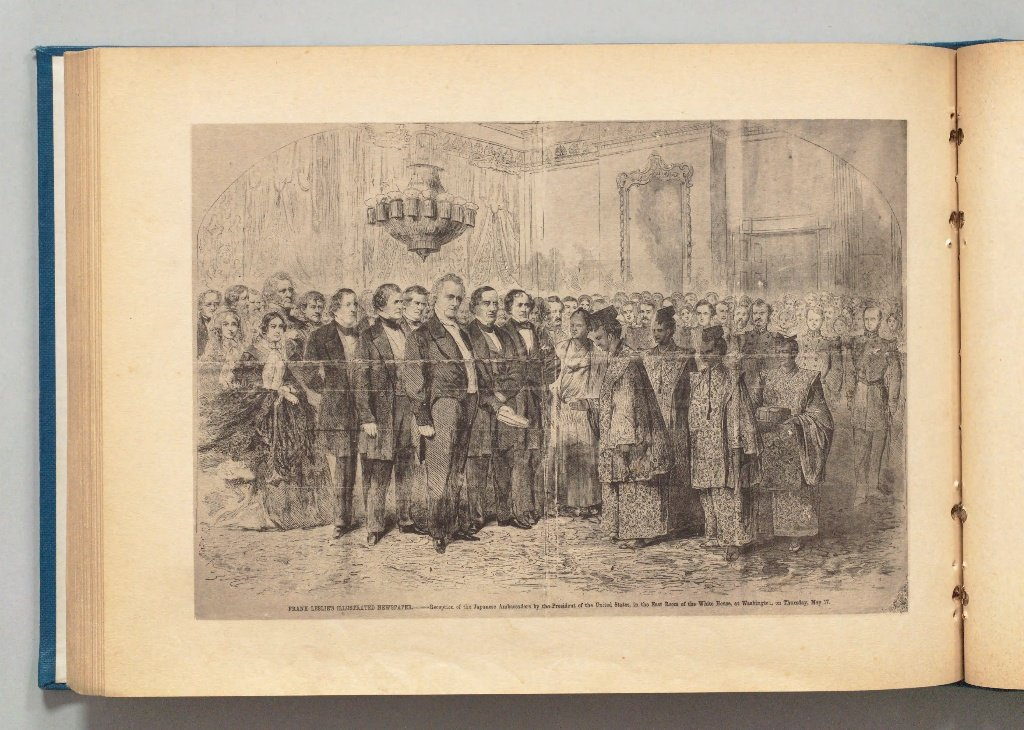
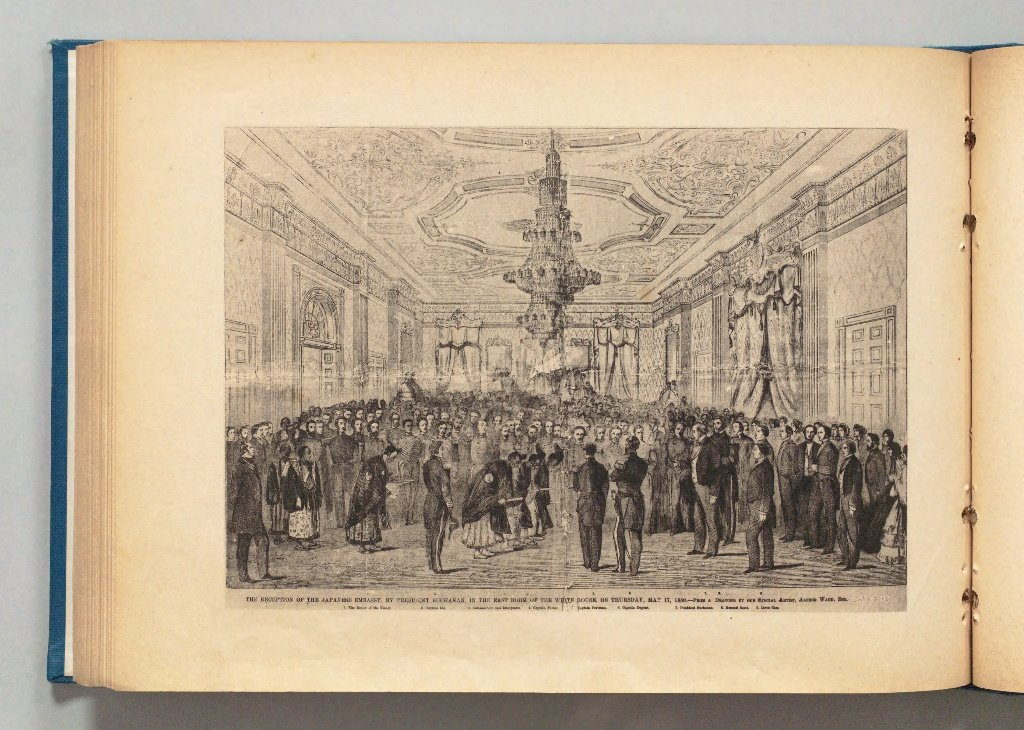
The embassy to the United States of 1860 was a large body of seventy-seven. The American papers wrote up its movements day after day, calling the party, when it had just landed, “strange visitors from the stars” (the New York Herald). Over a month and a half, though, the way they were looked at changed from curiosity about an exotic show to respect for an equal. And the man the reporters watched most closely was the inspector, Oguri — the man the American papers wrote of as “Oguro Bungo no Kami”.
“The Judge Black of the Japanese embassy”
Once the papers began carrying notices of the members of the embassy one by one, Oguri was treated in a class of his own.
The censor, Oguro Bungo no Kami, is a small man but a lively and expressive gentleman. Dignity, intelligence, conviction and a depth of feeling are mixed in him in a remarkable way
He is plainly a sharp man. It was with good reason that he was nicknamed at Washington “the Judge Black of the Japanese embassy”
An American newspaper of the time (quoted in Sakamoto Fujiyoshi, Oguri Kōzukenosuke no Shōgai)
The Judge Black meant here is Jeremiah Sullivan Black (1810–1883), who served as attorney general and as secretary of state and was, above all as a judge, among the most popular and respected men in the America of the day. A shogunal official of thirty-four was given, as a nickname, a name that in Japan would be Ōoka Echizen-no-kami or Tōyama Kinshirō.
Observations of how he carried himself
The reporters set down the way Oguri carried himself.
At receptions too, Oguro always stands upright with his head raised. His eyes are turned a very little downward, and he gives quiet, unbroken attention to every movement around him
Oguro is the centre of the embassy. Nothing can be decided without his consent. The severity of autumn frost runs through every part of him
In the same papers, the chief envoy Shinmi Masaoki was said to have “an easy dignity”, Morita Kiyoyuki, the head of a finance group, to be “the handsomest man of the embassy”, and Tsukahara, an inspector, to be “an intelligent and spirited young man”. Many of the party had their notices, but only of Oguri was it written that nothing could be decided without his consent. His title was neither chief envoy nor vice-envoy but inspector — and that was the real centre of the embassy as seen from outside.
Oguri's title of inspector, incidentally, was at first translated on the American side as “spy”, and there was a fuss about an embassy with a spy openly among its members. The misunderstanding was cleared up later, and the rendering settled on censor almost everywhere.
What the Americans were impressed by
What settled his reputation was the joint assay at the Philadelphia Mint. The ivory balance Oguri had brought, the speed of the abacus, the decimal system of weights — all of them filled the papers; but Sakamoto Fujiyoshi writes that when the test was over, what truly astonished the Americans was none of these. What impressed them most was the intelligence of the Japanese and their composure. Oguri stated plainly what he had to state, neither overbearing nor timid. There was no dissembling in him, and he was persistent besides. Out of that way of negotiating came a deep trust instead.
The New York Times, surprised that an embassy of seventy-seven had not a single priest in it, wrote this.
The Japanese are a race of a thoroughly rational character. … Nor does that mean they want imagination. … The Japanese are good, mild, and possessed of the highest intelligence in the world
After the joint assay, one paper wrote in good faith that this intelligent and energetic people, the Japanese, would surely in time stand as “teachers” to the Americans.
What held them within bounds
Through about a month and a half among the cities of the eastern United States, the embassy mixed fairly freely with the citizens and yet kept within bounds. Sakamoto Fujiyoshi sees this as the fruit of Oguri's judicious leadership as censor. It may seem a small thing, but the American papers wrote the envoys' names in the Japanese order, surname first, because the party did not fall in with Western usage and reverse them.
Not everything was to their credit, though. At a hotel in Baltimore two Japanese swords belonging to Hidaka Tamoyoshi, a subordinate directly under Oguri, were stolen. He had left the swords in his bedroom and was out on the balcony watching the welcoming fireworks, and it happened in that short while.
The reputation he won abroad anticipated exactly the work Oguri would do after his return, standing in the front line of negotiation as commissioner of foreign affairs and commissioner of finance. That a man written of across the sea as “the centre of the embassy” went long without a fair estimate at home is another thing not to be passed over in considering his life.
Sources: Sakamoto Fujiyoshi, Oguri Kōzukenosuke no Shōgai (the life of Oguri Kōzukenosuke), Kōdansha, 1987 (quoting articles from the New York Herald, the New York Times and other American papers)
→ The currency negotiation, and the balance at the Philadelphia Mint → Lieutenant Johnston's diary → Home by the Atlantic and the Cape of Good Hope