Over the Isthmus of Panama by rail, and transferred at Aspinwall on the Atlantic coast to the warship Roanoke, the embassy reached Washington at last on 14 May 1860. Nearly four months out from Shinagawa, this was the destination of the voyage.
They landed at the navy yard on the edge of the city. The vice-envoy Muragaki Awaji-no-kami's Kōkai Nikki notes the commotion of the day.
On shore men and women crowded together, climbing on to the houses and even on to the roofs to look on. Presently Dupont and the others led us ashore, and Commodore Buchanan came out to meet us; he too had come as a captain when Perry arrived in Japan. … Among them were the newspaper men, running about the place and writing something down.
The Buchanan who met them had come to Japan with Perry as a captain. A “photographic apparatus” was set up on the upper floor of the building opposite, and the landing was photographed. The photographs of Oguri in America that survive today come from that occasion. The party lodged at the Willard Hotel.
Visiting the State Department soon after his arrival, Oguri was taken aback by two things: that ladies were present at an official interview, and that not even a cup of tea was offered to a foreign envoy. A country that does not know courtesy, was his judgement then.
The twenty-eighth day of the intercalary third month, to the White House
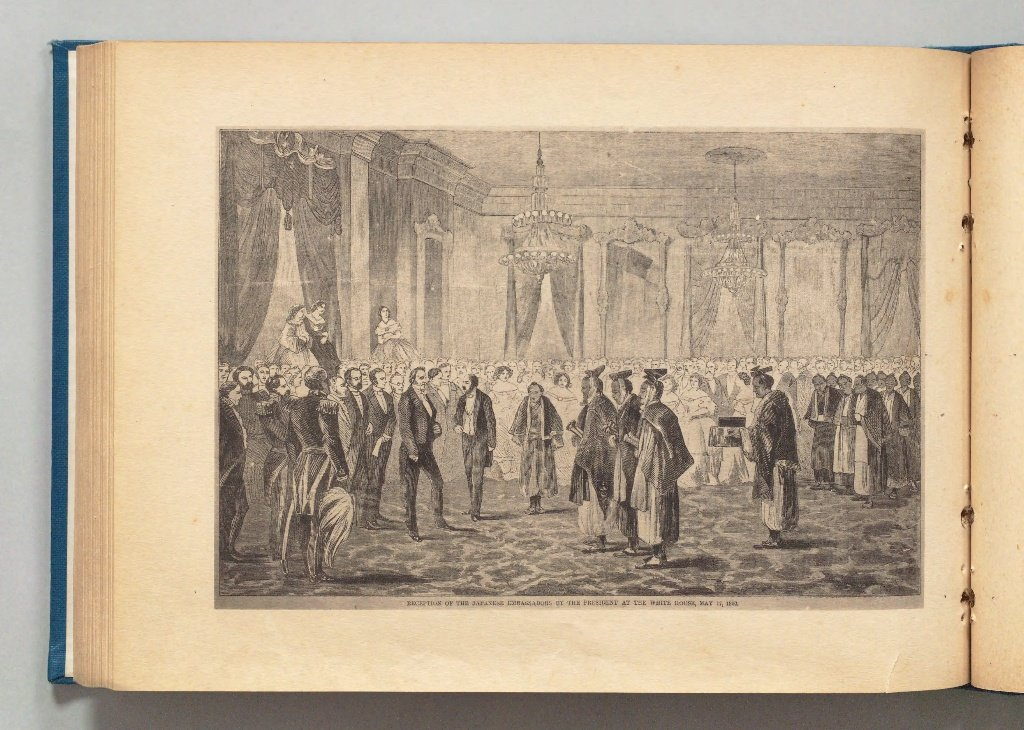
The audience was fixed for the twenty-eighth day of the intercalary third month — 17 May. The party put on their formal dress. Shinmi Buzen-no-kami Masaoki, the chief envoy, wore a kariginu robe with a sayamaki sword; Muragaki a kariginu with a kenuki sword; and Oguri Tadamasa a sayamaki sword, an eboshi cap with light-green cords, and woven sandals. Morita and Naruse Masanori wore hoi dress, the officers of arrangements and the foot inspectors suō, and the interpreter Namura Gohachirō a hemp jacket and trousers. Each of the three envoys had an American in attendance, and Oguri's was Letchart.
The procession leaving their lodgings went in this order: some twenty men in grey woollen tube-sleeved coats, thirty musicians, fifty-six cavalry, and then the long chest with the sovereign's letter, carried on a frame covered with red leather. Behind it came Shinmi, Muragaki and Oguri. The streets were packed with carriages and with men and women on foot, come to watch. Muragaki wrote this in his diary.
I was in my kariginu, a dress they are not used to seeing abroad, and they looked at it as something very strange; but I felt that I had come to such a barbarian country and was making the light of my own land shine there, and it is comical that I went along with a proud face, forgetting how small a man I am.
The White House struck them as plain. “Presently we came to the President's residence; there is an iron fence and gate, and going in and on for some seventy ken we reached the front of the hall.” To eyes used to the shogun's palace, the residence of a head of state marked off by nothing more than an iron railing and gate seems to have been unexpected.
“Come out again” — the party that nearly withdrew
The audience room was some five or six ken deep and twelve or thirteen across. President James Buchanan stood at the front, civil and military officers ranged to left and right, and a great many finely dressed ladies crowded in behind. Shinmi declared the shogun's words aloud and Namura Gohachirō interpreted. Naruse Masanori brought out the sovereign's letter, Shinmi handed it to the President, and the box was passed to Secretary of State Cass.
Here came an incident. Taking it that their business was done once the letter was handed over, the party withdrew briskly to the anteroom. Dupont, in attendance, came after them in haste and asked whether Japanese courtesy was satisfied. Told that it was, he said: come out once more. When they went back, the President took their hands and said that Japan had concluded a treaty of amity for the first time since closing the country, and had sent its first embassy to the United States; that he himself, and the people of the whole country, were without limit glad of it. He handed them a paper in Western script setting out what he had said.
The exchange of ratifications, and the signature “envoy and plenipotentiary”
Five days later, on the third day of the fourth month — 22 May — the ratifications of the Treaty of Amity and Commerce between Japan and the United States were exchanged: the formal step by which the two countries brought into force the treaty settled at Edo on the nineteenth day of the sixth month of 1858.
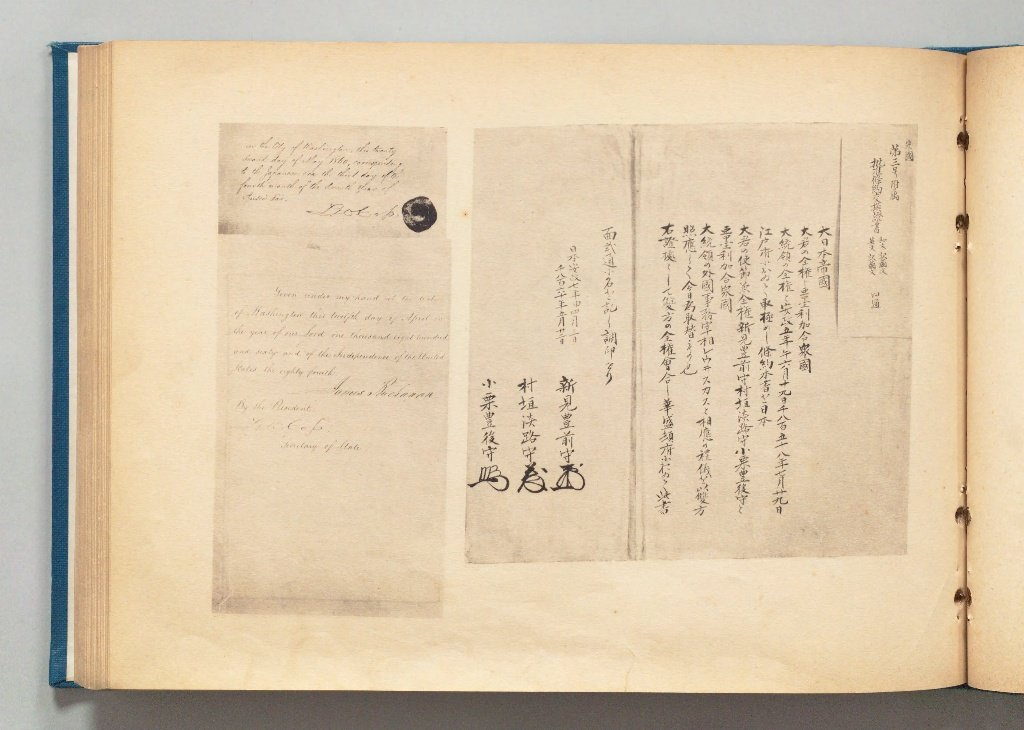
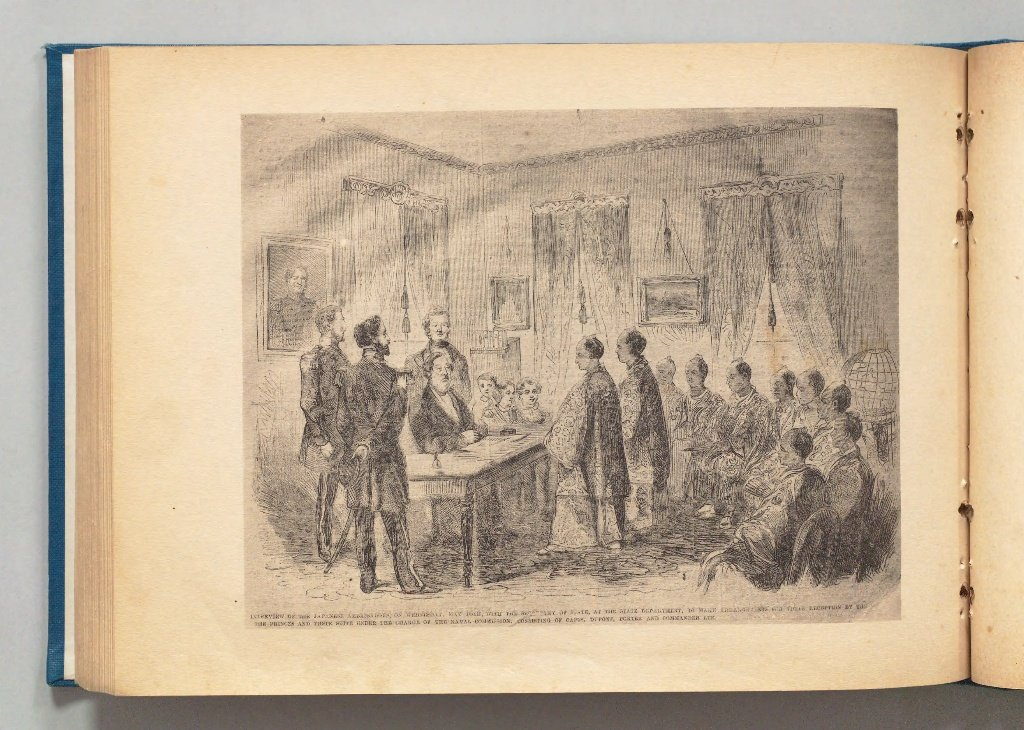
Oguri's standing shows in the wording of this instrument. It names “the envoys and plenipotentiaries of the Tycoon of Japan, Shinmi Buzen-no-kami, Muragaki Awaji-no-kami, Oguri Bungo-no-kami”, and the three of them signed and sealed it. The instrument was drawn up in Japanese and in English, with four copies of a Dutch translation. It has long been held that Oguri was no more than an attendant sent as censor, that is as inspector; Abe Dōzan cites this instrument to show that he was one of the formal plenipotentiaries. Shinmi, Abe writes, is said to have been chosen for his fine appearance and Muragaki for his skill with the pen, while Oguri was chosen as “a man with a head and a stomach, a man of clear understanding”.
The President's banquet, and Oguri's tug at a sleeve
On the sixth day of the fourth month the President gave a great banquet. The President sat at the head, with his niece Ellen facing him, Shinmi on her right and Muragaki on her left, and Oguri on the President's left. About thirty sat down to table, each with a lady beside him — an arrangement outside anything the Japanese took for granted.
Muragaki wrote frankly that, not knowing the manners, he watched the lady next to him eat and did as she did. He also recorded Ellen asking him whether the women of Japan or of America were the finer, and his answering that the American women were fairer of skin and better for it, which pleased her greatly.
That night came a scene well known in Japan. After the plates had been changed fourteen or fifteen times and the wine was done, a large glass bowl of water was brought out with a white cloth beside it: a finger bowl. Muragaki watched Ellen wash her fingers and wipe her mouth and did the same; Morita, though, took his up smartly and was about to drink from it. Oguri, beside him, tugged his sleeve. Morita took the point and washed his fingers. “We caught each other's eye,” Muragaki noted, “and it was hard work holding back the laugh.”
The gifts were set out on display, and they were asked how each was used. The green bamboo blinds and the folding screens were prized above all; asked what they were made of, the Japanese answered bamboo, at which came an admiring cry of “Bamboo!” The Japanese record adds that bamboo seems to be a thing neither America nor the West has.
Washington did not end Oguri's work, though. Alongside the exchange of ratifications, another heavy negotiation was going forward, over currency.
Sources: Abe Dōzan, Kaigun no Senkusha Oguri Kōzukenosuke Seiden (a true life of Oguri Kōzukenosuke, pioneer of the navy), Kaigun Yūshūkai, 1941 (quoting Muragaki Awaji-no-kami, Kōkai Nikki); Sakamoto Fujiyoshi, Oguri Kōzukenosuke no Shōgai (the life of Oguri Kōzukenosuke), Kōdansha, 1987; Kurabuchi Mura-shi (the Kurabuchi village history)
→ The currency negotiation, and the balance at the Philadelphia Mint