Having crossed the Pacific by way of Hawaii, the embassy reached San Francisco on the American mainland on the ninth day of the third month of 1860. It was the first moment an official Japanese embassy set foot on American soil.
The passage up to that point survives in the attendants' records. Satō Tōshichi, a retainer who accompanied Tadamasa and was village headman of Gonda, opens his “Short account of a voyage round the world” with the party at “seventy-six persons in all, high and low together”, and the ship sent to fetch them, the Powhatan, at “five hundred and thirty-eight persons in all”, “forty-six ken long and fourteen ken wide”. After they came out into the eastern Pacific on the twenty-fourth day of the first month, head seas and high winds gave them seven hard days; it calmed at last on the third day of the second month, and “high and low alike were relieved”. The heavy weather had burned too much coal for them to make San Francisco direct, so from the seventh day of the second month they turned south-east, and on the eighth day of that course, the fourteenth, entered Honolulu. They lay there seven days, sailed on the twenty-seventh, and he set the distance from there to San Francisco at “nine thousand two hundred ri by our country's reckoning”.
Yanagawa Kenzaburō, a retainer of Shinmi Buzen-no-kami, twenty-five years old, also left a journal of the voyage. On the eighteenth day of the first month of 1860 he went by way of Kudanzaka, Kamakura-gashi and Nihonbashi-dōri to the training station at Tsukiji, took his midday meal, boarded the Powhatan and went on to the port of Yokohama. The next day, the nineteenth, the commissioners of foreign affairs Sakai Oki-no-kami, Akamatsu Saemon-no-jō and Takemoto Zusho-no-kami, and the inspector Jinbo Hōki-no-kami, came aboard to see them off; on the twenty-second they sailed from Yokohama.
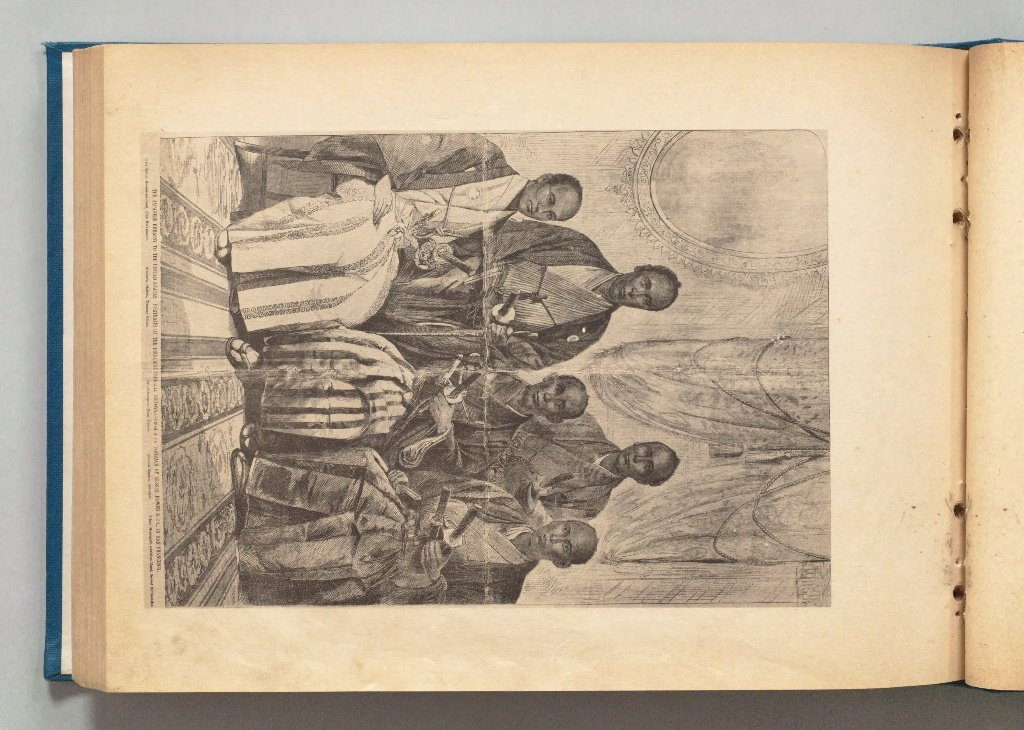
The reunion at Mare Island
The party did not go into the city at once on arrival. The Powhatan went on up the Sacramento River to the navy yard at Mare Island, where she was repaired and took on coal and provisions.
Here, for the first time since leaving Japan, the envoys met Kimura Settsu-no-kami, who had crossed ahead of them in the Kanrin Maru. The Kanrin Maru had left Shinagawa on the nineteenth day of the first month and reached San Francisco on the twenty-sixth day of the second month. The Powhatan, delayed by the audience with the king of Hawaii and the rest, came in a little later (Abe Dōzan, Kaigun no Senkusha Oguri Kōzukenosuke Seiden).
By Sakamoto Fujiyoshi's account, the three envoys and Morita Kiyoyuki called at Kimura's lodgings, and Kimura offered them a bath and brought out the Western liquor he had been keeping. They drank and talked until late in the night, and Tadamasa and Morita stayed over.
The visit to the mint
The first thing Tadamasa took up at San Francisco was a visit to the mint. The day after they arrived he sent off several letters to Japan urging that the outflow of Japanese gold be stopped, and four days after that, between the welcoming engagements, he visited the San Francisco branch of the United States Mint. The negotiation over currency and exchange with the Americans at Washington was still nearly two months off.
His companions' records survive too. Namura Gohachirō's diary has “fourteenth day, third month … went to the mint and to the customs house”, and Masuzu Shunjirō wrote of his admiration for the speed of the machine that struck silver and copper coins, which finished as many as seventy-two in “one minute”. The fullest is Morita Kiyoyuki's Akō Nikki, which gives the place, the kinds of coin and the stages of manufacture, and ends thus.
This treasury office — the coin manufactory — spends no manpower at all, but uses steam machines; water is drawn up to the second, third and fourth storeys by a leather pump, and whenever fire is needed it is all taken from gas. Its convenience and speed are beyond description.
What drew the eye was not the coinage itself so much as the arrangement that carried water and fire through the whole building with no human labour.
A record of watching a fire
The next date in Yanagawa Kenzaburō's journal is the sixteenth day of the third month, where he describes a fire he saw at the port of San Francisco. The ladders and the hand pumps were much like those in Japan, but he could see nothing else that looked like firefighting equipment, and there were hardly any onlookers. With the house next door burning, nobody made a commotion or tried to carry out so much as a piece of furniture. Japanese houses, Yanagawa noted, are made of wood and paper, so the spread of a fire can only be stopped by pulling buildings down; here the buildings are of tile and stone, so a fire is put out quickly and the disaster stays with the one house. It was a world away from Edo, where a crowd of gawkers rushes to a fire and mills about.
The stay was very short
The Powhatan left Mare Island on the sixteenth day of the third month. She came down the Sacramento River — thirty or forty chō wide where it is broad, twenty even where it narrows — reached San Francisco the same day and anchored. The seventeenth was for seeing the city, and on the eighteenth they sailed, heading south off the California peninsula for the Isthmus of Panama in Central America. Their stay in the city came in effect to a single day.
The Kanrin Maru's party stayed on at San Francisco: Kimura's task was to see whether the envoys reached Washington safely before going home.
The Pony Express, as it happens, sent out its historic first run from San Francisco on 3 April 1860, and the mailbag carried the news that the Japanese embassy had arrived there.
Sources: Ōtsubo Sadakata and Hozumi Odoroki, Oguri Kōzukenosuke, Oguri Kōzukenosuke o Shinobu Kai, 1975 (which prints Satō Tōshichi's “Short account of a voyage round the world” and Yanagawa Kenzaburō's journal of the voyage); Sakamoto Fujiyoshi, Oguri Kōzukenosuke no Shōgai (the life of Oguri Kōzukenosuke), Kōdansha, 1987; Abe Dōzan, Kaigun no Senkusha Oguri Kōzukenosuke Seiden (a true life of Oguri Kōzukenosuke, pioneer of the navy), Kaigun Yūshūkai, 1941
→ Crossing the Isthmus of Panama by rail → Testing the “myth” of the Kanrin Maru → Kimura Settsu-no-kami