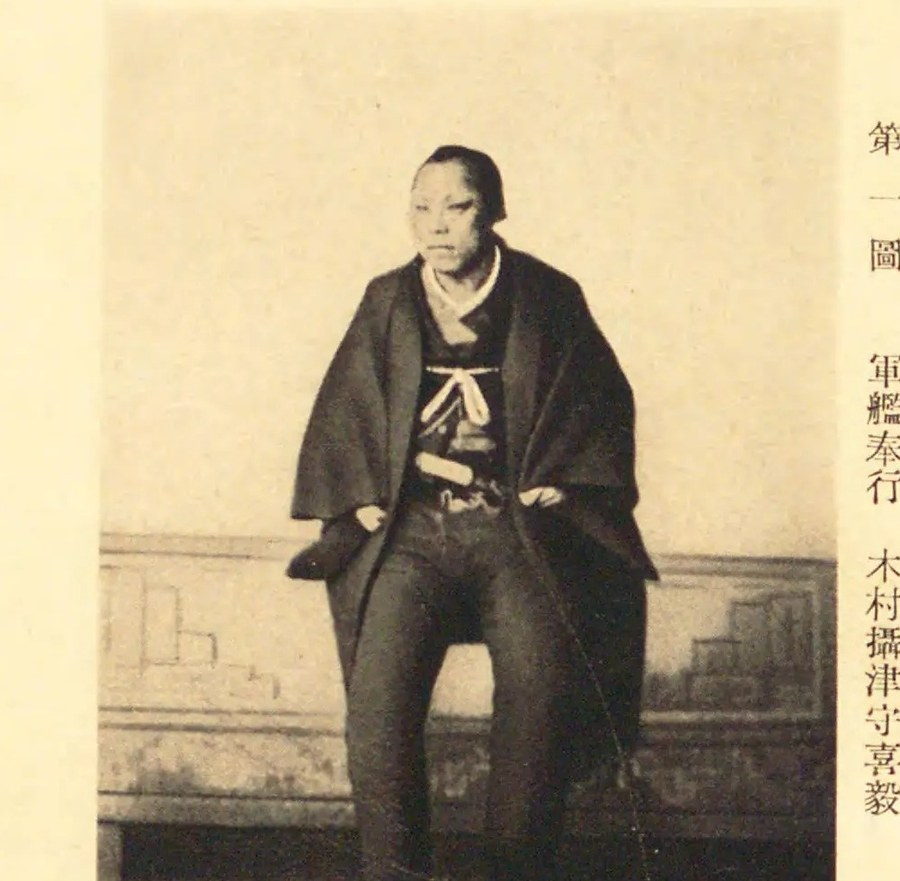
Kimura Yoshitake (Settsu-no-kami, with the pen name Kaishū) commanded the crossing of the Pacific as captain of the escort ship Kanrin Maru for the 1860 embassy to the United States. He was one of the men Abe Masahiro picked out; after becoming an inspector of the castle's main keep in 1856, he held in turn the posts of superintendent at Nagasaki, supervisor of the naval trainees at Nagasaki, and officer for the opening of the port of Kanagawa. When the embassy first began to be talked of he stood at the rank next below commissioner of warships, and on the twenty-eighth day of the eleventh month of 1859 he rose to commissioner of warships and was given the junior fifth rank and the title Settsu-no-kami.
On the first day of the twelfth month of 1859, when the three envoys Shinmi Masaoki, Muragaki Norimasa and Oguri Tadamasa were received by the shogun, Kimura was received at the same time. His charge was to see the embassy as far as its safe arrival at Washington, and to take the place of the three envoys should anything befall them (Sakamoto Fujiyoshi, Oguri Kōzukenosuke no Shōgai, the life of Oguri Kōzukenosuke).
The proposal to “send a second ship”
The sending of the Kanrin Maru has often been told as Katsu Kaishū's idea. Sakamoto Fujiyoshi, though, holds that those who pressed hard for a second ship were Mizuno Tadanori, Nagai Naoyuki, Iwase Tadanari and others. A memorial arguing that fitting out a second ship sailed by Japanese was desirable both for appearances before other countries and for the raising of a navy had already been submitted in the eighth month of 1858, two months after the treaty of amity and commerce with the United States was signed. It is also the case that the trainees of the naval school wanted an escort sent, and that Katsu, head of naval instruction, stood at their front.
After discussion the proposal of Mizuno, Nagai and Iwase was adopted, and Kimura was appointed to the overall charge of it on the twenty-fourth day of the eleventh month of 1859. The choice of the ship's company was left to him: he named Katsu Rintarō first, John Manjirō as interpreter, and Fukuzawa Yukichi as his own attendant. The complement was ninety-six Japanese in all, with eleven officers and men of the United States navy besides.
Of the ship herself, Kimura's diary Hōshi Meriken Kikō (an account of the mission to America) says: “the vessel to be fitted out this time is a hundred-horsepower steamer of the twisting kind, and is named the Kanrin Maru.” The “twisting kind” means screw propulsion. The shogunate had ordered her from the Fop Smit yard at Kinderdijk in the Netherlands, and her original name was the Japan. Her tonnage is given variously as 250, 300 and 470 — far smaller in any case than the 2,415 tons of the Powhatan, in which the embassy sailed. The Powhatan, though, was an old-fashioned paddle steamer, while the Kanrin Maru was of the newest kind then built.
He sailed with chests of a thousand ryō aboard
The story that Kimura put his own money into the voyage has a substance to it. Abe Dōzan's Kaigun no Senkusha Oguri Kōzukenosuke Seiden (a true life of Oguri Kōzukenosuke, pioneer of the navy) records that, while the Kanrin Maru's company — Katsu and Fukuzawa among them — were all poor samurai, Kimura alone came of a house of standing, and that, holding that “to go on a mission to a foreign country and there injure the country's standing would be a national disgrace”, he put the wealth handed down in the Kimura house into chests of a thousand ryō and loaded them aboard.
When they were troubled by storms, he is said to have put heart into the sailors by telling them the gold would be theirs, and, on parting from Lieutenant Brooke, to have thanked him for his services and offered: “take as much of this gold as you wish, as a parting gift.”
Oguri Kōzukenosuke comes into this story. The five hundred ryō Kimura had borrowed from the shogunate were repaid, after the return, to Oguri Kōzukenosuke, by then commissioner of finance (the same book). Two men who had crossed the Pacific together faced each other on the books, once home, as lender and borrower.
The decision to take Lieutenant Brooke aboard
What in fact carried the Kanrin Maru's voyage was Lieutenant John M. Brooke of the United States navy. By Brooke's journal of the voyage, the Japanese were all laid low with seasickness the day after they sailed, and Katsu did not come out of his own cabin. The bad weather held three days, and the only men able to work on deck were the American officers and seamen and, among the Japanese, three: Nakahama Manjirō, Ono Tomogorō and Hamaguchi Kōemon. Of the thirty-eight days of the whole voyage the weather was good on no more than four or five, and for more than two-thirds of it Brooke had the command.
It was Kimura's decision to take Brooke and his men aboard. Katsu, disliking it that they should be thought to have had American help, opposed it fiercely, but Kimura overrode him and had them embarked. After the return Katsu spoke, in his report to the shogunate and in Hikawa Seiwa alike, as though the thing had been done without foreign help; Kimura set down plain thanks in his Kikō.
A man of the gentlest nature, and accomplished in the art of navigation. That this man came with us on this voyage I count the greatest good fortune
For the return passage too he asked to hire eight American seamen, and five did sail with them.
The flag, and the salute
Two incidents arose on entering San Francisco. One was the flag. When the ship's officers settled to come in under the crest of Kimura, the commissioner of warships, Katsu would not have it: he was put out that it was not his own. The officers asked Brooke and the others what the custom was, and were told that “the flag of the commander-in-chief should of course be flown”; on hearing which, so the story goes, the officers hid Katsu's flag away somewhere.
The other was the salute. Katsu said it could not be managed and they should drop it; when the officer Sasakura Kiritarō answered that they could certainly fire it, he burst out: “nonsense — if you can, I will give you my head.” The salute was fired, and well. In his Kikō Kimura writes that Japanese officials are used to referring everything to their superiors, which cannot be done abroad, and goes on:
In the matter of the salute, for instance, we were able to act according to that country's courtesies without the least regard for what the shogunate's councillors might think, and it answered very well
So he wrote; it can be read as a quiet dig at Katsu. Kimura was known from childhood as an able student, served as inspector at Nagasaki at twenty-five, and was by nature a good listener to other men's views. Fukuzawa Yukichi's respect for Kimura, and his distaste for a Katsu who made light of him, led on to “Yasegaman no Setsu”.
A night at San Francisco
On 20 March 1860 by the Western calendar the Powhatan reached San Francisco, and Tadamasa and the others were reunited with the Kanrin Maru's party, who had arrived before them. On 30 March the three envoys and Morita Kiyoyuki went straight to Kimura's lodgings. Kimura offered them a bath and brought out Western liquor he had been keeping. They drank and talked till late in the night, and Tadamasa and Morita, drunk, stayed over at Kimura's.
When word came by Pony Express that the embassy was likely to reach Washington safely, the Kanrin Maru's party settled on going home. Some wanted to go on to Washington, some to sail round the world by the Cape of Good Hope, but Kimura chose to cross the Pacific straight back. The Kikō has it that “not to see the capital is a great regret”, and also: “the envoys having arrived safely … I am minded to sail home while nothing has gone amiss.” The Kanrin Maru left San Francisco at noon on 8 May by the Western calendar, called at Hawaii, and was back on 23 June (the fifth day of the fifth month by the Japanese calendar).
Sakamoto Fujiyoshi looks for the reason the Americans aboard judged the embassy and the Kanrin Maru so differently in the trust that held each group together. Shinmi and Kimura, at the head of each, were both figures of state, respected for their mildness, with nothing to choose between them; where the difference lay, on this reading, was in the leadership of Oguri and Katsu, the men with the real charge. The mild Kimura said almost nothing in later years and left the field to Katsu's publicity. That is part of why his name was buried.
Sources: Sakamoto Fujiyoshi, Oguri Kōzukenosuke no Shōgai (the life of Oguri Kōzukenosuke), Kōdansha, 1987; Abe Dōzan, Kaigun no Senkusha Oguri Kōzukenosuke Seiden (a true life of Oguri Kōzukenosuke, pioneer of the navy), Kaigun Yūshūkai, 1941
→ Testing the “myth” of the Kanrin Maru → Fukuzawa Yukichi → Landing at San Francisco