Mention the embassy to the United States of 1860 and the first names that come up are the Kanrin Maru and Katsu Kaishū. The story of a Pacific crossing made by Japanese hands alone is well known. But the ship that carried the main party — Shinmi Buzen-no-kami Masaoki as chief envoy, Muragaki Awaji-no-kami as vice-envoy and Oguri Bungo-no-kami as inspector — and bore the actual charge of exchanging the ratifications was the United States Navy's Powhatan. The Kanrin Maru was a separate ship that went along to escort them and to train her crew.
Who first called for sending the Kanrin Maru
It has commonly been said that sending the Kanrin Maru was Katsu's proposal. By Sakamoto Fujiyoshi's account, though, the despatch of a second ship to accompany the embassy began with pressing requests from Mizuno Tadanori, Nagai Naoyuki and Iwase Tadanari. The memorial arguing that fitting out a separate ship handled by Japanese was desirable for the country's standing abroad and for the building of a navy had already gone in by the eighth month of 1858, two months after the treaty was signed. There was a wish for an escort among the trainees of the naval school at Nagasaki as well, and Katsu, as head of naval instruction, did stand at the head of it. The proposal itself, however, was not his.
On the twenty-fourth day of the eleventh month of 1859 the man appointed to take overall charge of the second ship was the commissioner of warships, Kimura Yoshitake (Settsu-no-kami). Kimura's official task was to see whether the embassy reached Washington safely, and to take the place of the three envoys if anything befell them. Unofficially there were also the effect abroad of sending a Japanese warship across the Pacific, and a secret aim of finding uninhabited islands on the voyage and seeing whether they could be made Japanese territory.
Kimura named the ship's company himself: Katsu Rintarō first among them, John Manjirō among the interpreters, and Fukuzawa Yukichi as Kimura's attendant. Ninety-six Japanese sailed in her, with eleven officers and men of the United States Navy besides. The ship had been ordered by the shogunate from the Fop Smit yard in the Netherlands, and her original name was the Japan. Kimura wrote in his Hōshi Meriken Kikō that she was “a hundred-horsepower steamer with a twisting gear, named the Kanrin Maru”. The twisting gear means a screw; smaller than the paddle steamer Powhatan of 2,415 tons, she was all the same a ship of the newest type then.
Four or five fine days out of thirty-eight
What matters is how the voyage actually went. It was Kimura's decision to take Lieutenant John M. Brooke of the United States Navy and his men aboard the Kanrin Maru. Katsu objected fiercely: he disliked the thought of its being said that they had been helped by foreigners.
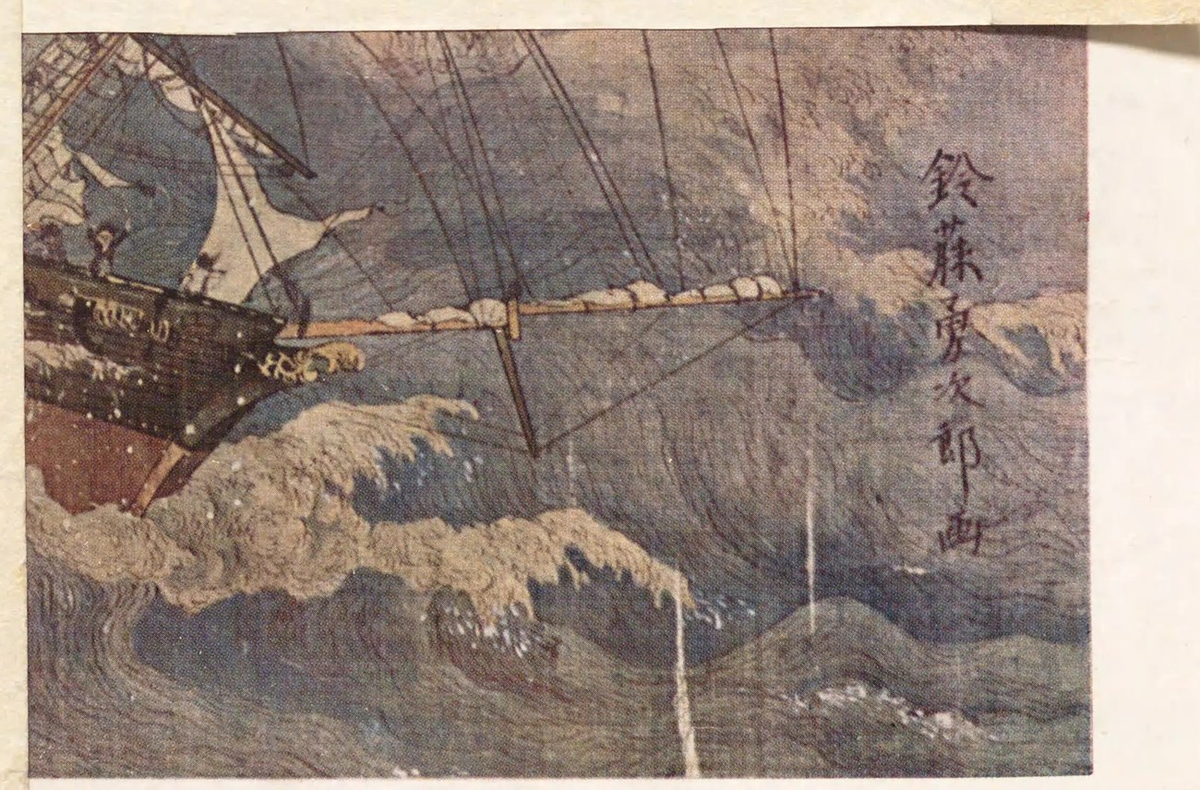
The decision taken over that objection saved the ship in the end. By Brooke's journal of the voyage, every one of the Japanese was laid low by seasickness the day after they sailed. A storm came up on the evening of the twentieth day of the second month, the day after the departure, worsened on the twenty-first, and the gale and rain held for three days. During that time the only men able to work on deck were the American officers and sailors and, among the Japanese, just three: Nakahama Manjirō, Ono Tomogorō and Hamaguchi Kōemon.
Of the thirty-eight days of the whole voyage, only four or five had good weather. And for more than two-thirds of the passage it was Brooke who commanded. Katsu, by the record, kept to his cabin and was in no state to command at all.
Katsu nevertheless spoke, in his report to the shogunate after the return and later in Hikawa Seiwa (his recorded talks), as though the thing had been done by Japanese hands alone, without foreign help. Fukuzawa Yukichi, for his part, wrote in Fukuō Jiden (his autobiography) that the courage and the skill of deciding to set out without anyone's help were an honour to Japan. The decision was real; the event did not follow the decision — that is how Sakamoto sets it out.
Kimura's pen was candid. Of Brooke he left this.
A man of the gentlest nature, and accomplished in the art of navigation. That this man came with us on this voyage I count the greatest good fortune
For the return voyage too, Kimura and Katsu asked Brooke to let them hire eight American sailors, and five in fact sailed with them.
The flag and the salute — two incidents at San Francisco
Two commotions arose as they came into San Francisco. The first was over the flag. The ship's officers decided to enter port flying the crest of Kimura, the commissioner of warships; Katsu would not have it, displeased that the flag was not his own. The officers asked Brooke and the others what the usage was, and were told that of course the flag of the senior commander should be flown. On hearing it, the officers are said to have hidden Katsu's flag away somewhere.
The second was over the salute. By Fukuō Jiden, Katsu said it could not be managed and should be dropped — firing half-heartedly and making a mess of it would be a disgrace — and the officer Sasakura Kiritarō answered that they could certainly fire it. Katsu flared up: “Nonsense. If you can, you may have my head.” The salute was fired beautifully. Kimura wrote in his account of the voyage that he had ordered the salute on his own authority and that it succeeded, with a jab at Katsu implied. In later years Kimura took Katsu's behaviour to come of dissatisfaction with his own rank.
The reunion at San Francisco
The Powhatan reached San Francisco on 20 March 1860, the eighth day of the third month by the Japanese calendar. There Oguri and the others met again the party of the Kanrin Maru, which had arrived before them. On 30 March the three envoys and Morita Okatarō Kiyoyuki called at Kimura's lodgings. Kimura offered them a bath and brought out the Western liquor he had been keeping. They drank and talked until late in the night, and Oguri and Morita, the worse for it, stayed over at Kimura's.
After repairing her damage at San Francisco, and on word that the embassy had reached Washington safely, the Kanrin Maru sailed at noon on 8 May by the Western calendar and came home to Japan by way of Hawaii on 23 June, the fifth day of the fifth month by the Japanese calendar.
The difference as the Americans aboard saw it
The judgements of the Americans aboard the two ships stood in contrast. The Japanese in the Powhatan did not change colour in a storm and never uttered a complaint — when Lieutenant Johnston told a newspaper reporter so, it made an article that moved American readers. Of the Kanrin Maru, on the other hand, even Lieutenant Brooke, the best disposed of all towards the Japanese, wrote in his journal that he was appalled at the slackness of the Japanese officers and sailors aboard. Sakamoto sees one cause of the difference in the trust within each body of men, and above all in the difference of leadership between Oguri and Katsu as men who led by their own competence.
None of this denies the worth of the Kanrin Maru's story. That a warship under the Japanese flag crossed the Pacific straight across, rather than island by island, was a great undertaking for the time. The question is how the story was used afterwards. The Meiji government of the Satsuma and Chōshū cliques, and the nationalist education that came after it, abused the treaties the shogunate had concluded as unequal treaties and treated the embassy that went to exchange their ratifications as meaningless. By the same reasoning the escorting Kanrin Maru should have been equally culpable; she alone, though, was praised for “the feat of crossing the Pacific by Japanese strength”. Men who went on to serve the Meiji government with distinction had sailed in her.
Sources: Sakamoto Fujiyoshi, Oguri Kōzukenosuke no Shōgai (the life of Oguri Kōzukenosuke), Kōdansha, 1987 (drawing on Kimura Yoshitake, Hōshi Meriken Kikō; Brooke's journal of the voyage of the Kanrin Maru; and Fukuzawa Yukichi, Fukuō Jiden)
→ A courtesy visit to the Kingdom of Hawaii