On the twelfth day of the ninth month of 1859 Oguri Tadamasa was appointed inspector of the main keep, in the foreign affairs section, as a supernumerary beyond the establishment of ten. The next day, the thirteenth, he was summoned to the Fuyō Room of Edo Castle, and there, before the great councillor Ii Kamon-no-kami Naosuke and the senior councillors in attendance, Abe Shimōsa-no-kami declared to him:
“You are to be sent to the country of America for the exchange of the ratifications of this treaty; make your preparations accordingly.”
A charge of this weight came one day after he became inspector. The natural reading of an appointment dated the day before is that the title of inspector was given him as the prerequisite for making him an envoy. Three men received their orders at that same sitting.
Chief envoy Shinmi Buzen-no-kami Masaoki (commissioner of foreign affairs and commissioner at Kanagawa) thirty-nine
Vice-envoy Muragaki Awaji-no-kami Norimasa (commissioner of foreign affairs, commissioner at Kanagawa, commissioner at Hakodate and commissioner of finance) forty-seven
Censor Oguri Bungo-no-kami Tadamasa (inspector) thirty-two
Set beside the other two, the appointment was a marked advancement for Tadamasa. In the eleventh month of the same year he was given the junior fifth rank, lower grade, with the title Bungo-no-kami, and from then on he stood in the diplomatic arena as Oguri Bungo-no-kami. On the first day of the twelfth month he was received by the shogun Iemochi in the White Audience Hall of the western keep, was formally ordered to go to America, and was granted ten pieces of gold, a set of seasonal robes and a haori. On the twenty-fourth day of the twelfth month he went to Kanagawa with the chief envoy, the vice-envoy and Kimura Settsu-no-kami Yoshitake, who was to go separately in the Kanrin Maru, and called on the American commodore aboard the Powhatan to confer with him.
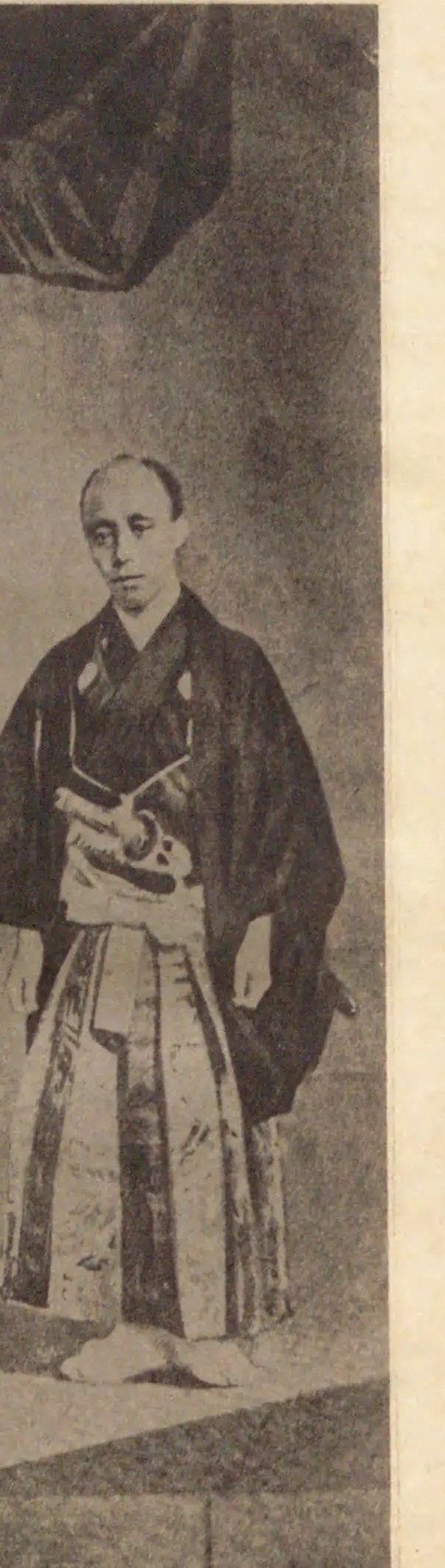
The first choice was a different set of men
That the ratifications would be exchanged at Washington had been settled in the talks between Iwase Tadanari and Harris, and was written into the fourteenth article of the treaty. The first choice of envoys had fallen, unofficially, on Mizuno Tadanori (commissioner of foreign affairs), Nagai Naoyuki (the same) and Iwase Tadanari (inspector). On the sixth day of the seventh month of 1858 Abe Shimōsa-no-kami had told them, with the great councillor Ii in attendance, to prepare for the voyage.
Ii, however, wanted to keep out men who had taken to foreign ways and men close to the Mito party in the question of the shogun's succession. Tadanari was removed first, then Naoyuki was relieved of the commissionership of foreign affairs, and when Tadanori resigned to take responsibility for the killing of a Russian, the embassy had to be put together afresh from the beginning. Men who had had no hand in concluding the treaty were to go — that was the condition Ii set.
Muragaki met the condition and happened to be commissioner of foreign affairs at that moment. Shinmi was appointed commissioner of foreign affairs only in the seventh month of 1859, six months before the departure; he had come up through the pages and was a handsome man. It has been pointed out that Japan had minded the looks of the envoys it sent abroad as far back as the embassies to Sui China.
Why Tadamasa?
Explanations of Oguri's selection have been offered since early on. Ninagawa Arata put it this way in Ishin Zengo no Seisō to Oguri Kōzukenosuke no Shi (the political struggle around the Restoration and the death of Oguri Kōzukenosuke).
“Shinmi, it is said, was chosen chief envoy above all for his handsome appearance, his origin among the pages, his correct bearing and measured manner with others, and his imposing presence; Muragaki was chosen vice-envoy for his skill with the pen. Oguri alone was marked out and raised up by the great councillor Ii … for the uncommon quality of his ability and his nerve.”
Ōtsubo Motoji's Oguri Kōzukenosuke Tadamasa Kakei oyobi Ryaku-nenpu likewise records the tradition that Tadamasa's despatch to America came of Ii Naosuke's picking him out, Ii having seen his exceptional quality and judged that he would become a man of consequence in the shogunate. There are writers such as Kaionji Chōgorō who reject the explanation by appearance, and there is also the view that the shogunate did not in truth weigh the choice heavily; no source settles it. Still, that a young Tadamasa, clear in his views and ready to act, was set beside Shinmi of the fine appearance and Muragaki the seasoned, capable official is taken to have had its reasons. His command of swordsmanship, horsemanship and gunnery may have counted too with Ii, who wanted foreigners to recognize what the Japanese could do.
There was besides a tangled argument over whether the sovereign's letter the embassy carried should be in English or in Japanese; that too was decided by Ii Naosuke, in favour of Japanese.
An adoption against the worst
With so weighty a charge before him, Oguri put his own affairs in order. Crossing the Pacific and returning then meant a voyage of six months to a year, and shipwreck on the way or some unforeseen turn of events abroad were real dangers. If anything happened to him, the house of Oguri would end with no heir. To prevent that he took Masako of the hatamoto house of Kusaka as an adopted daughter, and Tadamichi (Matakichi), second son of the hatamoto Komai Kai-no-kami, as his adopted heir, the two of them to succeed to the house together as husband and wife in time. As head of a hatamoto house of 2,500 koku, he made the continuance of the house certain before going out on public duty — the caution of a samurai of that time.
That year and more abroad was the starting point from which Oguri rose, after his return, to commissioner of foreign affairs and then to commissioner of finance. He never met again the man who had raised him up: by the time Tadamasa came home, the great councillor Ii had been assassinated outside the Sakurada Gate.
Sources: Sakamoto Fujiyoshi, “Hyōgo Shōsha” o Tsukutta Saigo no Bakushin: Oguri Kōzukenosuke no Shōgai (the last shogunal official, the man who created the Hyōgo Shōsha: the life of Oguri Kōzukenosuke), Kōdansha, 1987; Ōtsubo Motoji, Oguri Kōzukenosuke Tadamasa Kakei oyobi Ryaku-nenpu (the genealogy and short chronology of Oguri Kōzukenosuke Tadamasa), Oguri Kō Kenshōkai, 1957; Koitabashi Ryōhei, Oguri Kōzukenosuke Ichizoku no Higeki (the tragedy of the Oguri family), and Tatsunami, the journal of the memorial society
→ Sailing from Shinagawa — seventy-seven men put to sea / Coming home without knowing of the killing at the Sakurada Gate