On the eighteenth day of the first month of 1860 the embassy gathered first at the naval training station at Tsukiji, and that afternoon went aboard the Powhatan, the ship sent to fetch them, which lay off Shinagawa. Headed by Shinmi Buzen-no-kami Masaoki as chief envoy, Muragaki Awaji-no-kami Norimasa as vice-envoy and Oguri Bungo-no-kami Tadamasa as inspector, and counting the interpreters and the attendants, it was a large body of seventy-seven in all. The Americans seem to have expected a smaller Japanese embassy, and are said to have been taken aback by the number.
The departure brought two firsts in form as well. The ratification the three envoys carried bore, after the shogun's seal and the signatures of the officials who had signed the treaty, the words “the Empire of Great Japan” at the end. And as the embassy left Japan, a national flag was formally settled on — the sun flag of today.
A ship whose guns came out to make cabins
The United States Navy's Powhatan, which carried the party, was of 2,415 tons: a paddle steamer with a great wheel on either side of the hull, large enough, but already of an old type as ships went. Four of the guns she had carried were taken out and the space made over into cabins for the embassy before she came to Japan to fetch them.
The voyage turned rough from the moment they sailed. A few of the days in Morita Okatarō Kiyoyuki's record run as follows.
Twenty-third day, first month Gale and heavy rain
Twenty-fourth day, first month Gale and high seas. One seaman fell from the mast
Twenty-fifth day, first month Gale and heavy rain. Morita Kiyoyuki thrown off his feet
Twenty-seventh day, first month Water in the cabins. The ship heeled thirty-five degrees. A boat and the pickle tubs washed away
Thirty-five degrees of heel carries the fear of the men aboard without further comment. The storm had one unlooked-for side effect, though: with the pickle tubs gone overboard, the American sailors were relieved of the smell.
Morita Kiyoyuki, the man who kept the accounts
Morita Okatarō Kiyoyuki, who kept the record just quoted, joined the party by promotion from head of a finance group. He ranked above Katsu Rintarō of the Kanrin Maru, and had orders to take Oguri's place as one of the envoys should anything happen to him. A specialist in finance and accounts, he worked as Oguri's right hand throughout the journey.
The Akō Nikki (his journal of the voyage to America) and the Amerika Kōkai Shutsunyū-bo (the account of receipts and payments on the American voyage) that he left are meticulous records, as befits the man answerable for the money, and are sources of the first rank for the inner workings of the embassy. Morita also kept a separate secret notebook for matters that could not be made public, a small one, ten centimetres by sixteen, which he called the Mudai Tebikae (untitled memoranda) or the Bessatsu Hichō (the separate secret book). What was said when he and Oguri differed, and the exchanges between Oguri and Secretary of State Cass, were written there.
The Kanrin Maru, a second ship
A second ship went with them: the shogunate's warship Kanrin Maru. Kimura Yoshitake (Settsu-no-kami) was made her commander on the twenty-fourth day of the eleventh month of 1859, was promoted commissioner of warships four days later, and was given the junior fifth rank with the title Settsu-no-kami. The choice of the ship's company was left to Kimura: Katsu Rintarō was picked as the first of them, John Manjirō was among the interpreters, and Fukuzawa Yukichi was named as Kimura's attendant. The complement came to ninety-six Japanese, with eleven officers and men of the United States Navy besides.
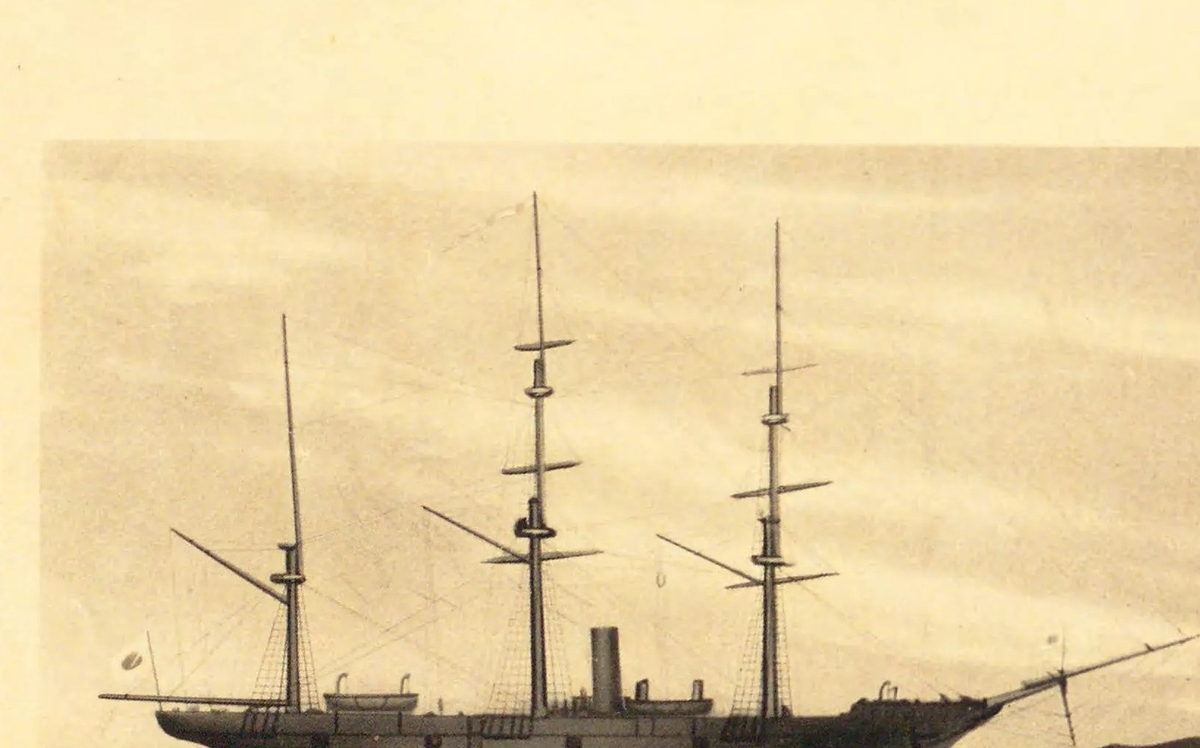
Kimura's journal, the Hōshi Meriken Kikō (an account of the mission to America), calls the Kanrin Maru “a hundred-horsepower steamer with a twisting gear”. The twisting gear means a screw. She was built to the shogunate's order at the Fop Smit yard at Kinderdijk in the Netherlands, and her original name was the Japan. Smaller than the Powhatan, she was the newer type of the two.
Kimura's open task was to see the embassy safely to Washington, and to take the place of the three envoys if anything befell them. Unofficially, it is said, there were two further aims. One was the effect at home and abroad of sending a Japanese warship across the Pacific. The other was a secret order kept even from the Americans: to find as many uninhabited islands as possible on the voyage and, if it could be managed, to make them Japanese territory.
It is often said that sending the Kanrin Maru was Katsu Kaishū's proposal, but Sakamoto Fujiyoshi points out that it was Mizuno, Nagai and Iwase who pressed for a second ship. The memorial arguing that fitting out a separate ship handled by Japanese was desirable for the country's standing abroad and for the building of a navy had already gone in during the eighth month of 1858, two months after the treaty was signed.
At the first port of call
Through the heavy weather, the party landed at what the record calls “the port of Honolulu, Oahu island, among the Sandwich Islands, in the Pacific sea” — Honolulu on Oahu in Hawaii. The first place Oguri went to see there was a newspaper office. Standing before the press, he was astonished at its speed. Morita Kiyoyuki set it down in the Akō Nikki.
“The wheel of the machine is called a press; it prints so fast that it does some sixteen hundred sheets in a day.”
It was the main party aboard the Powhatan — Shinmi, Muragaki, Oguri and the rest — that went to America charged with exchanging the ratifications. The Kanrin Maru sailed separately as far as San Francisco and turned back for Japan from there. For Oguri at thirty-four, it was the first time he had been away from Edo so long.
Sources: Sakamoto Fujiyoshi, Oguri Kōzukenosuke no Shōgai (the life of Oguri Kōzukenosuke), Kōdansha, 1987 (including its quotations from Morita Kiyoyuki, Akō Nikki, and Kimura Yoshitake, Hōshi Meriken Kikō)
→ Testing the “myth” of the Kanrin Maru → The call at Hawaii → Kimura Settsu-no-kami Yoshitake