Trace the Yokosuka ironworks back to its beginning and it goes much further back than 1865, to the embassy to the United States of 1860. Of all that Oguri Tadamasa, who crossed as inspector (metsuke), saw in the capital at Washington, what moved the rest of his life most was the United States Navy's Washington Navy Yard.
The party reached Washington on the twenty-fifth day of the third month of 1860. Kōkai Nikki, the voyage diary of the vice-envoy Muragaki Awaji-no-kami, records that at noon they put in at “the Nebiyārto at the edge of the town (that is, the navy yard)”. Men and women crowded the bank, and “climbed on to the houses and even on to the roofs to look on”. Commodore Buchanan came out to meet them. Muragaki adds that “he too had come as a ship's captain at the time of Perry's arrival”. An officer of the squadron that had come to Uraga seven years before was here to receive the Japanese envoys. On the twenty-eighth day of the third month they presented the sovereign's letter to President Buchanan, and on the third day of the fourth month the treaty ratifications were exchanged.
The day of the visit, as Lieutenant Johnston set it down
The full visit to the yard came a few days later. The diary of Lieutenant Johnston of the United States Navy, who went with the party, gives the day in detail.
Two naval commissioners took the party to the yard, and after the chief envoy had replied to Captain Buchanan's words of welcome they went round the grounds and saw the work of each department. In the machine department they saw the large engine then being built for fitting into the warship Pensacola, and exclaimed over it again and again. In the gun department they watched in turn the making and filling of percussion caps, the making of bullets for the Minié rifle, and the casting and finishing of brass howitzers. Johnston writes that the Japanese praised “the excellence of American skill and the great scale of the work”, and were “at once delighted and astonished”.
A commemorative photograph was then taken, with the envoys set in front and the officers of the yard ranged behind them together with the attendants and the newspaper reporters.
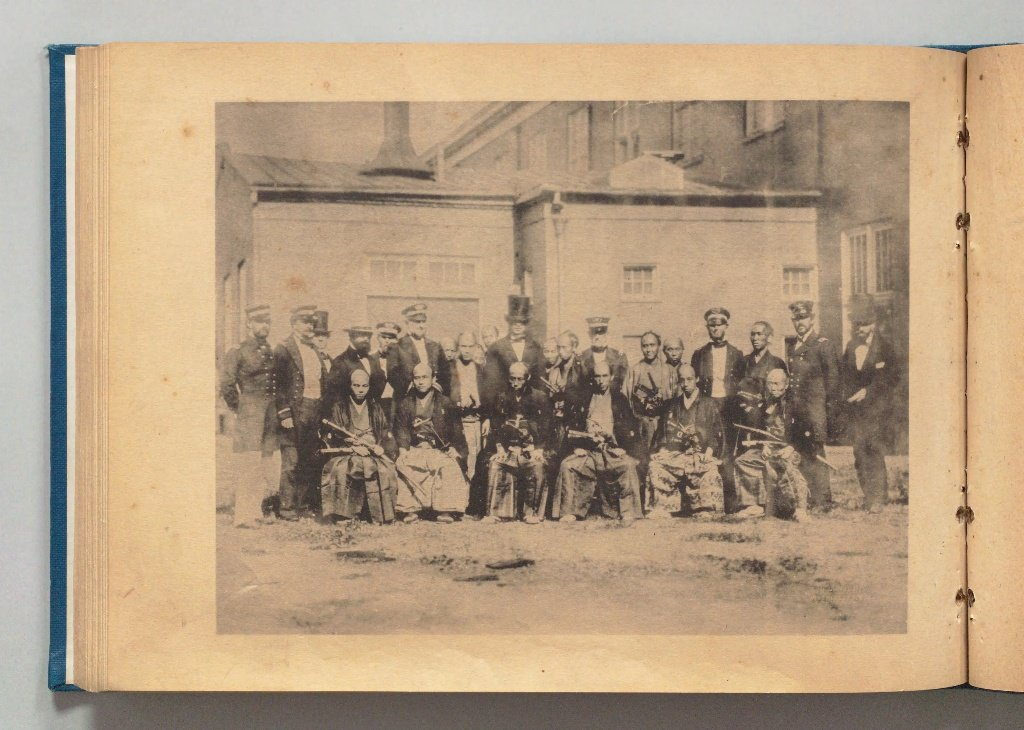
When the photograph was done, the Americans fired a finely made Dahlgren gun and a howitzer for them. By Johnston's account the Japanese opened their eyes in wonder, and as they watched the shot skim away over the surface of the river they looked well satisfied.
Abe Dōzan notes of this visit that “there is naturally a gap between Muragaki's diary and the American's diary of the party's visit to the yard”, and writes that at this visit Oguri settled something deep in himself.
Why the navy yard
Japan had at that time no general works that could be set beside it. The shogunate had, late in the day, established the naval training station at Nagasaki — at the senior councillor Abe's instance, with Nagai Genba-no-kami in charge of it — and, taking over three ships from the Netherlands, had begun teaching navigation and tactics. But the skill to build and to mend a ship by their own hands was still beyond them. Ships there might be, but if they could not be repaired the navy could not move when the moment came — that was what Oguri took in as he walked through the yard.
Hattori Itsurō, a great-grandson of Muragaki Awaji-no-kami, set down a scene aboard ship on the homeward passage, at evening, with the American continent falling away behind: Oguri standing alone at the ship's side, apart from the rest (quoted by Sakamoto Fujiyoshi). There, by that account, he said to himself the following.
“Their advance in the investigation of nature — in science — is what I envy most. The machinery of that shipyard, the equipment of that mint: these we must by all means bring into our own country. So we shall build strength enough to stand against the nations of the world. Yes — I shall do it myself.”
It is a reconstruction by a later hand, and cannot be read as a record as it stands. What Oguri saw on this voyage, though, was not the Washington yard alone. On the way home he inspected the Dutch shipyard on Onrust Island off Java (they left Batavia on the tenth day of the tenth month), and he saw the wretched state of the British colonies for himself. Sakamoto Fujiyoshi sums it up as having “gone round the world in the newest of American ships and seen the navy yards of the several countries at first hand”.
It begins to move four years later
Back in Japan, Oguri returned to the centre of the shogunate's government as commissioner of finance and commissioner of warships, but the idea of a shipyard did not become a plan at once. It began to move in the twelfth month of 1864, from the day he stopped Kurimoto Sebei (later Joun) on a street corner at Yokohama and put to him there what might be done with the machinery presented by the Saga domain. Kurimoto wrote in his notes that he was “hearing the word dock for the first time”, while on Oguri's side lay the memory of the yard he had walked through four years before.
On the tenth day of the eleventh month of 1864, in the names of the senior councillors Mizuno Izumi-no-kami, Abe Bungo-no-kami and Suwa Inaba-no-kami, the building of two works — a shipyard and an arsenal — was decided. The machinery presented by the Saga domain was gathered at Yokohama first, and the building of the small Yokohama ironworks began. This was the “arsenal”. Abe Dōzan calls the Yokosuka naval arsenal “a by-product of that crossing to America of seventy-odd years ago, so full of memory, which set the blood of the young Oguri racing”.
Sources: Abe Dōzan, Kaigun no Senkusha Oguri Kōzukenosuke Seiden (a true life of Oguri Kōzukenosuke, pioneer of the navy), Kaigun Yūshūkai, 1941 (including quotations from Muragaki Awaji-no-kami's Kōkai Nikki and from Johnston's diary); Sakamoto Fujiyoshi, Oguri Kōzukenosuke no Shōgai (the life of Oguri Kōzukenosuke), Kōdansha, 1987
→ The embassy to the United States, and the currency negotiation → Friendship with Kurimoto Joun, and the repair of the Shōkaku → The machinery presented by the Saga domain