Speak of Oguri Kōzukenosuke's grave and Tōzenji at Gonda, near the place of the execution, comes first. But there is a grave with Tadamasa's name cut on it in Tokyo as well: the “grave of the generations of the house of Oguri”, which stands in the metropolitan Zōshigaya cemetery at Minami-Ikebukuro, Toshima ward, in plot 1-4-B-5, north of the cemetery office. Ōtsubo Motoji's Oguri Kōzukenosuke Tadamasa Kakei oyobi Ryaku-nenpu (the genealogy and short chronology of Oguri Kōzukenosuke Tadamasa) also records, of the man who became the fourteenth head of the house, that he was “buried in the Zōshigaya cemetery, Tokyo”.
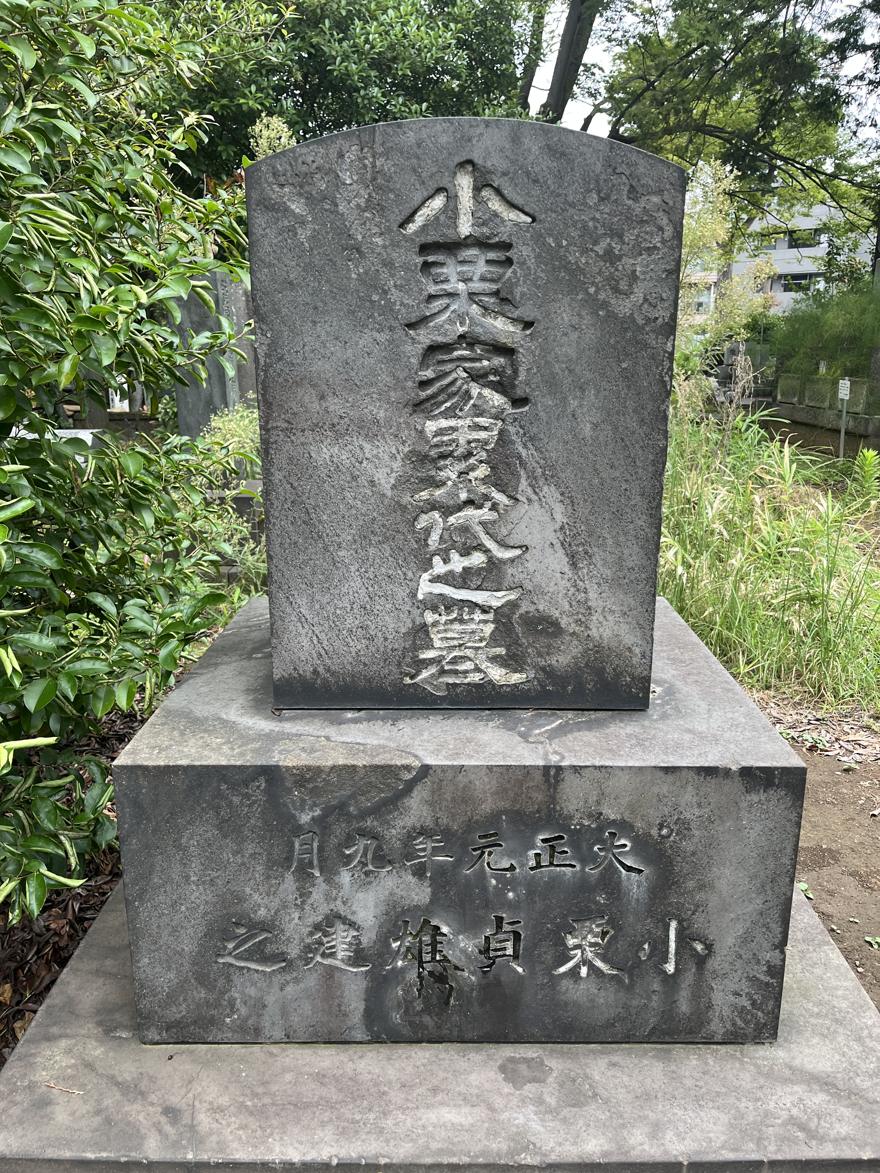
It was raised by the daughter's husband
The base is cut “September 1912, raised by Oguri Sadao”. Forty-four years after Tadamasa's execution, the man who raised it was not Tadamasa's own child but the husband of his only daughter, Kuniko, who was born at Aizu.
Oguri Sadao was born a Yano. He was the younger brother of Yano Fumio (Ryūkei), known as a journalist and politician of the Meiji era, and was born on the twenty-eighth day of the eleventh month of 1861, the third son of Yano Teizō (Mitsunori), of samurai family, of Saiki in Bungo — now Ōita prefecture. When his father became governor of Katsushika prefecture and the family landed at Yokohama in January 1870, Sadao was still eight, it is said.
Both brothers studied at Keiō Gijuku. The elder, Fumio, was deputy chief writer of the Yūbin Hōchi Shinbun, became Ōkuma Shigenobu's right hand, and took the presidency of the paper when Ōkuma bought it. When, in 1886, Fumio set about his great reform of the failing Hōchi Shinbun, the man who stood up to carry it through was his brother Sadao, then twenty-six. Sadao had been an English teacher at a middle school, and he came before the public as a “speech man”, that is, a public speaker.
The match was made by Ōkuma Shigenobu and his wife. Ōkuma's wife Ayako came of the hatamoto Saegusa family and was a cousin of Tadamasa's. Kuniko was brought up in the Ōkuma house. The household register records that on 10 December 1887 Sadao “became head of the household on marrying into it”. Sadao afterwards founded the Ōgibashi Pharmaceutical Company and made the medicated soap “Arbose”, and set up the Jippi Shinryōjo, a chartered association of clinics, aiming at medicine for the public. Ninagawa Arata set down Sadao as he then was: “Sadao was an educator, a newspaperman, a member of parliament, a man of business”.
The four names on the back
On the back of the stone stand four names: Tadamasa and his wife, and his daughter and her husband.
Oguri Kōzukenosuke died the sixth day of the intercalary fourth month, Meiji 1 aged forty-two
His wife Michiko died the twenty-seventh day of the twelfth month, Meiji 19 aged fifty-two
Oguri Sadao died the sixteenth of March, Shōwa 10 aged seventy-five
His wife Kuniko Shōwa 4 aged sixty-threeThe month and day could not be read, the stone being worn.
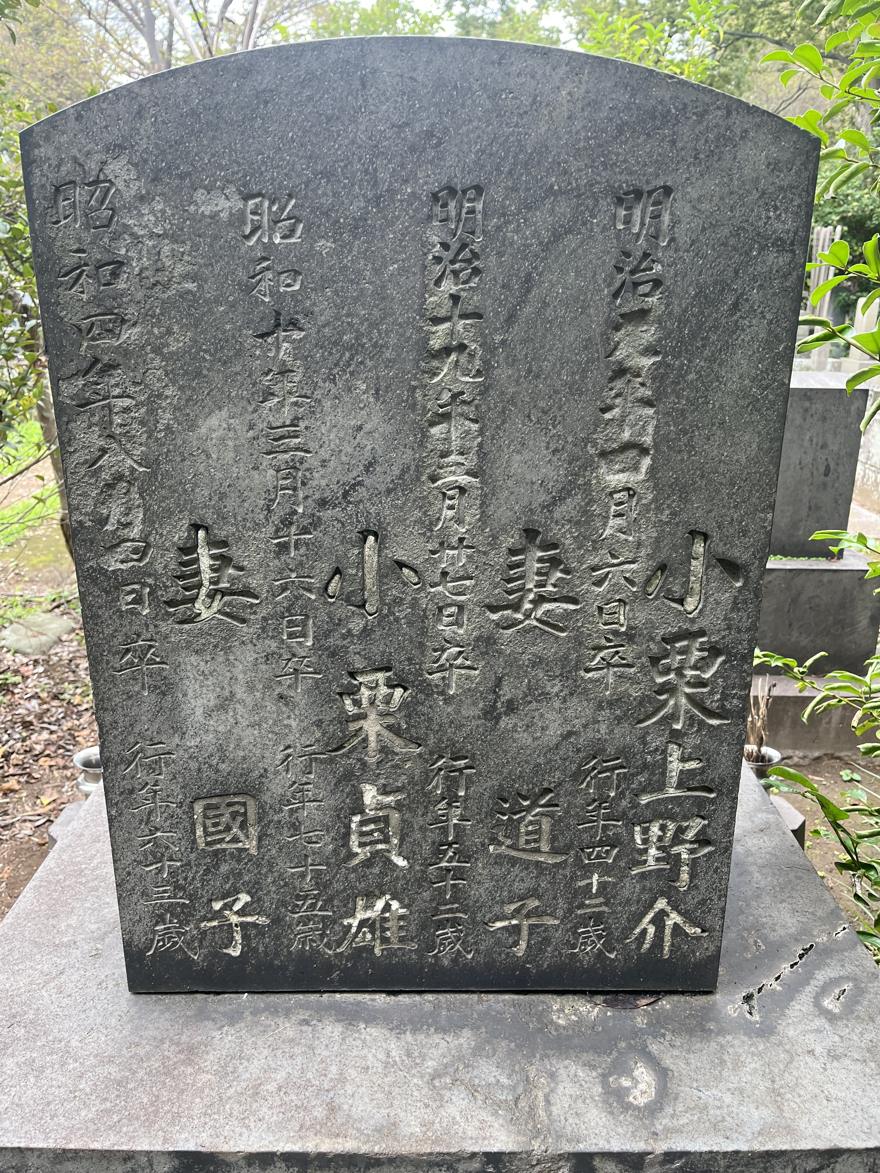
The years of death cut here agree well with the written record. Ōtsubo Motoji's chronology calls Kuniko “the only blood of the house of Oguri” and records that she was born in the castle town of Aizu in the sixth month of 1868 and died on 4 August 1929, at sixty-three. By the household register she died at Nishi-Suma in Kobe. Of Sadao it says died 16 March 1935 at Senzoku in Meguro, Tokyo, at seventy-five, which is exactly what this stone has.
Why it is cut “the sixth day of the intercalary fourth month, Meiji 1”
Tadamasa was cut down on the sixth day of the intercalary fourth month of Keiō 4. On this stone that becomes “Meiji 1”. It is not a mistake in the cutting.
The edict changing the era name came on the eighth day of the ninth month of that same year, but under the rule of one era to a reign, settled at that time, the year was made Meiji 1 retrospectively, from its first month. Keiō 4 and Meiji 1 are the same single year. To write an event of the intercalary fourth month as “Meiji 1” follows that rule.
His wife Michiko's date of death is on this stone too: the twenty-seventh day of the twelfth month of 1886, aged fifty-two. Scholars differ on the year of Michiko's birth — 1834, 1838 or 1839 — and the count does not agree from one record to another. Sadao and Kuniko were married on 10 December of the following year.
The year: September 1912
Taishō 1 began with the change of era on 30 July 1912, so “September 1912” is two months after it. Within that one year, things happened one after another around the house of Oguri.
On 7 April, at the village of Shimosaida in the old fief — later Takikawa village — a new gravestone was raised for the adopted heir Matakichi and his retainers. That day was the forty-fifth anniversary of the disaster; the stone was paid for by more than a hundred subscribers from the villages of the old fief, Shimosaida among them, and from around the town of Takasaki, and a representative of Sadao came to the village for the family, where a great memorial service was held. In July, Sadao and his son Matakichi, then fourteen, were invited to the house of Marshal Tōgō Heihachirō. Tōgō, who gave the building of the Yokosuka shipyard as a cause of the victory in the war with Russia, offered as they parted to give them a piece of writing to mark the day, and at Sadao's request it was inscribed to Matakichi, who had come with him. The writing reads “benevolence, duty, propriety, wisdom, faith”.
For the navy as a public body to acknowledge Tadamasa's services in writing, however, took three years more, until the fiftieth anniversary of the founding of the Yokosuka naval arsenal in 1915. This stone is a grave the family raised with their own hands before any public commemoration began.
The family from before the end of the shogunate is not here
The name “grave of the generations” makes it look as though the heads of the house lie here one after another, but what is cut on the stone is only the family from Tadamasa on. The Oguri family temple in Edo was Hozenji at Ushigome Yokodera-chō, also written Tōridera-chō, fixed as the family temple from the time of Masanobu, the fifth, and set down as the main house's family temple in the Kansei Chōshū Shokafu as well. Following Ōtsubo Motoji's chronology, each head of the house in turn is written down as “buried at Hozenji, Ushigome Tōridera-chō”. The generations before Tadamasa were buried there, and their names do not appear on this stone. Hozenji stood at Ushigome until 1906 and has since moved to Nakano ward.
How close this temple was to the daily life of the house of Oguri the Oguri Nikki shows. In the entries for the days he was in Edo, notes of sending a retainer to worship in his place on the anniversary of a forebear's death appear month by month — “it being the anniversary of Chūkō-in's death, Yūzaemon went out to Hozenji to worship in my place” — and at the New Year and the year's end his mother went herself. His father Tadataka died of illness at the Niigata commissioner's official residence on the twenty-eighth day of the seventh month of 1855; his ashes were buried at Hōonji in Teramachi, Niigata, and part of them was brought to this temple. The “Chūkō-in” that appears again and again in the diaries is that father's name in religion.
The sides are cut with the names of generations after Sadao and Kuniko as well. Since they include people who died in recent years, this page shows only the front and the back.
If you go
It is a metropolitan cemetery, so it is open to visitors in the daytime. Other families' graves stand right beside it, so please take care how you walk the paths and where you point a camera. It is at Minami-Ikebukuro 4-chōme, Toshima ward, within walking distance of Zōshigaya station on the Tokyo Metro Fukutoshin line or the Toden Zōshigaya stop on the Toden Arakawa line.
Sources: photographs taken at the site on 1 September 2026; Ōtsubo Motoji, Oguri Kōzukenosuke Tadamasa Kakei oyobi Ryaku-nenpu (the genealogy and short chronology of Oguri Kōzukenosuke Tadamasa), Oguri Kō Kenshōkai, 1957; Koitabashi Ryōhei, Oguri Kōzukenosuke Ichizoku no Higeki (the tragedy of the Oguri family), and Tatsunami, the journal of the memorial society; Oguri Nikki (the Oguri diaries), Gunma Prefecture Historical Materials vol. 7.
→ The list of the places / Kuniko, “the only blood of the house of Oguri”, born at Aizu / His father Tadataka's death, and the succession / Was there a concubine? — “Oaya” in the household accounts