When the shogunate's army was beaten in the fighting at Toba and Fushimi, which began on the third day of the first month of 1868, the shogun Tokugawa Yoshinobu left Osaka Castle and returned to Edo by sea in the Kaiyō Maru. He came in off Shinagawa on the evening of the eleventh day of the first month and landed at the Hama palace early on the twelfth. Both Oguri and Katsu Kaishū hurried there to meet him.
Yoshinobu got back to the castle after ten at night on the twelfth. At eleven that night the officials were all summoned to the Fuyō Room. The shogun is said to have told them that a great change had come and the house stood in peril of its existence, and that every man should state his opinion without reserve. The argument grew confused — men weeping, men angry, men shouting, all together — and went on far into the night. Through it all, Oguri alone is said to have shown nothing in his face.
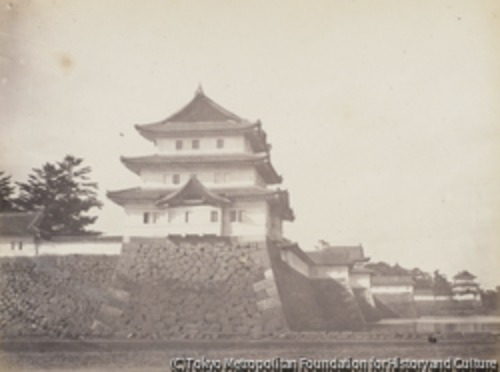
Sixteen hours of council
Oguri's own diary records the next day in these words alone.
Thirteenth day. Hour of the dog. Fine weather. — Went up to the castle after the fifth hour; left at the eighth hour of the night.
He went up to the castle a little after five in the morning and left at two the next morning. With almost no sleep he went up again and faced sixteen hours of argument. Kurabuchi Mura-shi records that on this day the shogun gathered the daimyo and hatamoto then in the castle in the great hall and held a great council, which split into those for fighting and those for submission and had not come together even by nightfall.
Not one of the senior men gathered there thought of the other side as an imperial army; they took them for the private troops of Satsuma and Chōshū. Most were therefore for fighting. But none of them set out an argument squarely and pressed the shogun with it. The man who came forward on his knees was Oguri. Koitabashi Ryōhei's Oguri Kōzukenosuke Ichizoku no Higeki quotes this passage from Higashikuze's recollection, “The council at Edo Castle”.
A small dark-skinned man with pockmarks, of no great presence; but his eyes glittered and went through you, and the moment those lips, set in a straight line, opened, the voice rang out and the argument came in order, and he pressed his lordship with the great cause of fighting on. Even Lord Yoshinobu was put out of countenance by it.
His argument was not spirit alone. The force coming east would not exceed thirty thousand. In that case the barrier at Hakone should be opened and the imperial army let easily into Edo, and then Hakone closed and the Kiso road of the Tōsandō blocked as well, so that they were rats in a bag. With half the warships holding Suruga and the other half striking at the sea off Osaka, the lords of the Kantō would mostly come over to the Tokugawa side. It was a recommendation with a concrete plan of operations behind it.
Gripping the hem of his trousers
Yoshinobu, who had settled on submission in his own mind while still at Osaka, rose to withdraw to the inner rooms. Oguri gripped his hem and would not let go. A document handed down in the Tsukakoshi Shin'ichi family at the village of Gonda sets the scene down thus.
As soon as Yoshinobu came back east he went straight in and urged him to fight. He spoke bitterly, argued fiercely, remonstrated to the utmost and would not withdraw. When Yoshinobu rose to go within, he came forward and gripped his hem, and argued on, it is said, and still would not let go. It was in this very session that he received the most severe order of dismissal. In the two hundred and sixty years of the shogunate, he alone was dismissed from office by the shogun's own word.
A shogun relieving a man of office with his own mouth — in three hundred years of Tokugawa rule, this is said to be the only instance.
Driven into a corner by Oguri's argument, Yoshinobu came near to resolving on war; but if he were beaten again as at Toba and Fushimi, this time his own life would be in danger. The thought made him faint-hearted and his resolve weakened again. So he dismissed Oguri and turned back to submission — that is how “The council at Edo Castle” explains it.
A diary written flatly
The next day, the fourteenth, it snowed. The diary says only that he went up to the castle earlier than the usual hour and left about the seventh hour of the night. Then, on the fifteenth day of the first month, the formal warrant came down.
Fifteenth day. Hour of the rat. Fine weather. — Went up to the castle at the usual hour; in the afternoon Lord Suō-no-kami handed me a cut-paper warrant saying that, business requiring it, I was to present myself at the western keep. As it said there was no need to change dress, I told my colleagues so and went round to the chamber, where in the Fuyō Room Sakai Uta-no-kami declared that I was relieved of office and placed on ordinary attendance. Left after the seventh and a half hour of the evening. — Sent notice of the above to my colleagues and to my relatives.
He was handed the warrant, written on a cut sheet of paper, by Matsudaira Suō-no-kami, and was told of his dismissal by Sakai Uta-no-kami in the Fuyō Room. He writes that and no more, with not one word of how he felt. The entry for the fifteenth day of the first month in Zoku Tokugawa Jikki (the further true records of the Tokugawa) likewise reads: “Commissioner of finance, acting commissioner of the army, holding both: Oguri Kōzukenosuke. Cut-paper warrant.” Honda Natsuhiko, the editor of Oguri Nikki, judged that this day's entry too “sets down nothing but the surface of things, flatly and plainly”.
This diary covers the four months from the first day of the first month to the first day of the intercalary fourth month of 1868, written in Oguri's own hand, and was later handed down in the Gotō family of Shibukawa. The Gotō were wholesalers at the post station of Shibukawa; after Oguri's execution they dealt with the confiscation and disposal of the Oguri property by order of Ōne Ryūtarō, inspector of the general staff, and the diary is said to have come into their hands then.
Thirteen days after the dismissal, on the twenty-eighth day of the first month, Oguri submitted his petition to settle at the village of Gonda in Kōzuke, part of his holding, and it was granted the next day, the twenty-ninth. He left Edo on the twenty-eighth day of the second month.
Sources: Kurabuchi Mura-shi (the Kurabuchi village history), quoting the documents of the Tsukakoshi Shin'ichi family of Gonda and Oguri Nikki; Koitabashi Ryōhei, Oguri Kōzukenosuke Ichizoku no Higeki (the tragedy of the Oguri family), quoting Higashikuze's recollection “The council at Edo Castle”; Oguri Nikki (the Oguri diaries), Gunma Prefecture Historical Materials vol. 7, edited by Honda Natsuhiko
→ The Hakone plan that never was → The petition to settle at the village of Gonda