The techniques and the people developed at the Yokosuka ironworks spread into fields beyond shipbuilding. The chief instance is the Tomioka silk mill, now on the World Heritage list.
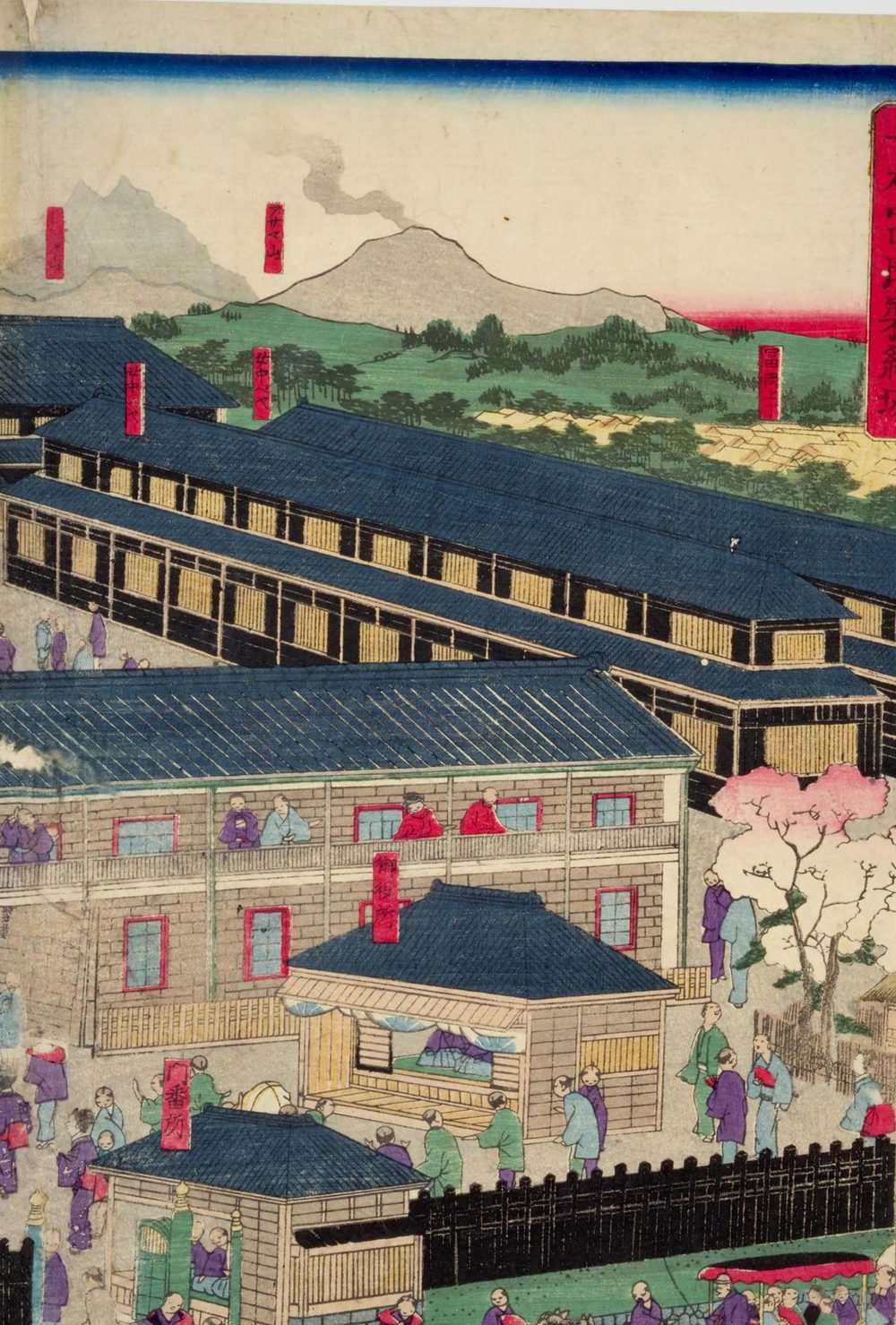
The engineers and carpenters who came from Yokosuka
The timber-framed brick buildings of the Tomioka silk mill were designed by the French building engineers then engaged on the Yokosuka shipyard. The design was Bastien's, and he was sent to Tomioka to put his experience of building at Yokosuka straight to use. The drawings were made in French and the measurements were metric. It was a way of designing and of building wholly unlike the traditional practice of Japan at the time.
The men who actually put the buildings up were the Japanese carpenters who had been working at Yokosuka. A dozen or more went with him from Yokosuka to Tomioka, and under the French engineers' direction raised buildings of a kind of construction they had never seen. The term allowed is said to have been a mere fifty days, and without the readiness trained into them on the site at Yokosuka it would have been hard to manage.
How they were trained at Yokosuka can be seen from the ironworks' rules on education. Youths of the samurai class were selected as “engineer pupils” and taught French and the several branches of engineering, while boy workmen chosen by the French foremen became “foreman pupils”, working in the shops in the morning and learning drawing and other subjects at the school in the afternoon. The system taught not the skill of making one particular product but the practices common to Western building and Western machinery. That is why they could work as they stood on the site of a silk mill, an undertaking wholly unlike shipbuilding.
The machinery of working life came too
At the Tomioka silk mill, as at Yokosuka, fixed working hours, Sunday as a day of rest, monthly wages, pay by length of service and pay by skill were introduced as well. Not the buildings and the machines alone but the whole arrangement of running a modern works was carried from Yokosuka to Tomioka.
The raw silk the shogunate tried to hold
Behind the placing of a government silk mill at Tomioka lies the weight raw silk had carried as a commodity since the shogunate's last years. From the opening of the ports in 1859, raw silk was Japan's largest export, and shipments from Yokohama were growing fast. Oguri set about changing a state of affairs in which foreign trading houses held most of the profit.
The shogunate had until then tried to control the Yokohama consignment merchants through the wholesalers of Edo, and had not succeeded. Oguri changed the approach: he recognized the Yokohama consignment merchants themselves, gave them autonomy, and turned to managing the trade through them.
Fifth month, 1865 Chosen men among the Yokohama consignment merchants were given the privilege of exporting cocoons and silkworm eggs.
First month, 1866 The order on the re-sealing of raw silk and silkworm eggs was promulgated. Inspection by the Edo wholesalers of raw silk forwarded to Yokohama was abolished, and the sealing was to be done in the producing districts.
1866–67 The raw-silk consignment merchants of Yokohama were directed to form trade associations. The consignment merchants regulated the trade themselves and grew stronger against the foreign houses.
Oguri meant to make raw silk a national export directed to France. On the ninth day of the second month of 1865 the British and Dutch ministers asked for an interview with the senior councillor Mizuno Tadakiyo and the junior councillor Sakai Tadamasu, and demanded to know whether it was true, as they had heard, that there was a plan to export raw silk in bulk to a single market in Europe in order to buy ships and arms. The councillors turned this aside, saying that it was only to be expected that the purchase money “must be met out of the surplus produce of Japan”.
By Kaionji Chōgorō's Oguri Kōzukenosuke, which Kurabuchi Mura-shi quotes, Oguri, after Roches took up his post, considered a plan for a monopoly in raw silk, by which the shogunate would control Japanese silk and export it to France in a single hand; protests from the United States, Britain and the Netherlands kept it from being carried out. Ōtsubo Motoji's Oguri Kōzukenosuke Tadamasa Kakei oyobi Ryaku-nenpu likewise records, under the seventh month of 1867, a plan made with Roches to found a company in Paris, to act as the shogunate's agent in Europe, exhibit at the Paris International Exposition, and in particular hold a monopoly in raw silk in order to buy arms.
The plan by which the shogunate meant to hold raw silk as the country's chief export disappeared with the collapse of 1868. But both the idea of making raw silk the pillar of foreign earnings and the engineers and carpenters trained at Yokosuka passed to the Meiji government as they stood. When a government model mill was built at Tomioka in Jōshū, the two came together.
Sources: Sakamoto Fujiyoshi, Oguri Kōzukenosuke no Shōgai (the life of Oguri Kōzukenosuke), Kōdansha, 1987; Ōtsubo Motoji, Oguri Kōzukenosuke Tadamasa Kakei oyobi Ryaku-nenpu (the genealogy and short chronology of Oguri Kōzukenosuke Tadamasa), Oguri Kō Kenshōkai, 1957; Kurabuchi Mura-shi (the Kurabuchi village history)
→ Training shipbuilders — a school inside the works → The Franco-Japanese joint-company scheme