Building the Yokosuka ironworks called for easy communication with the body of French engineers. The drawings, the specifications and the talk on site all ran in French. Kurimoto Joun, writing years later, looked back on three undertakings of this period as one.
In the shogunate's last days, the beginnings of the founding of the Yokosuka shipyard, of the army training school and of the French language school all turn on my own person, and all three are linked and run on together, so that one cannot be taken up and the other two set aside. (Hōan Ikō)
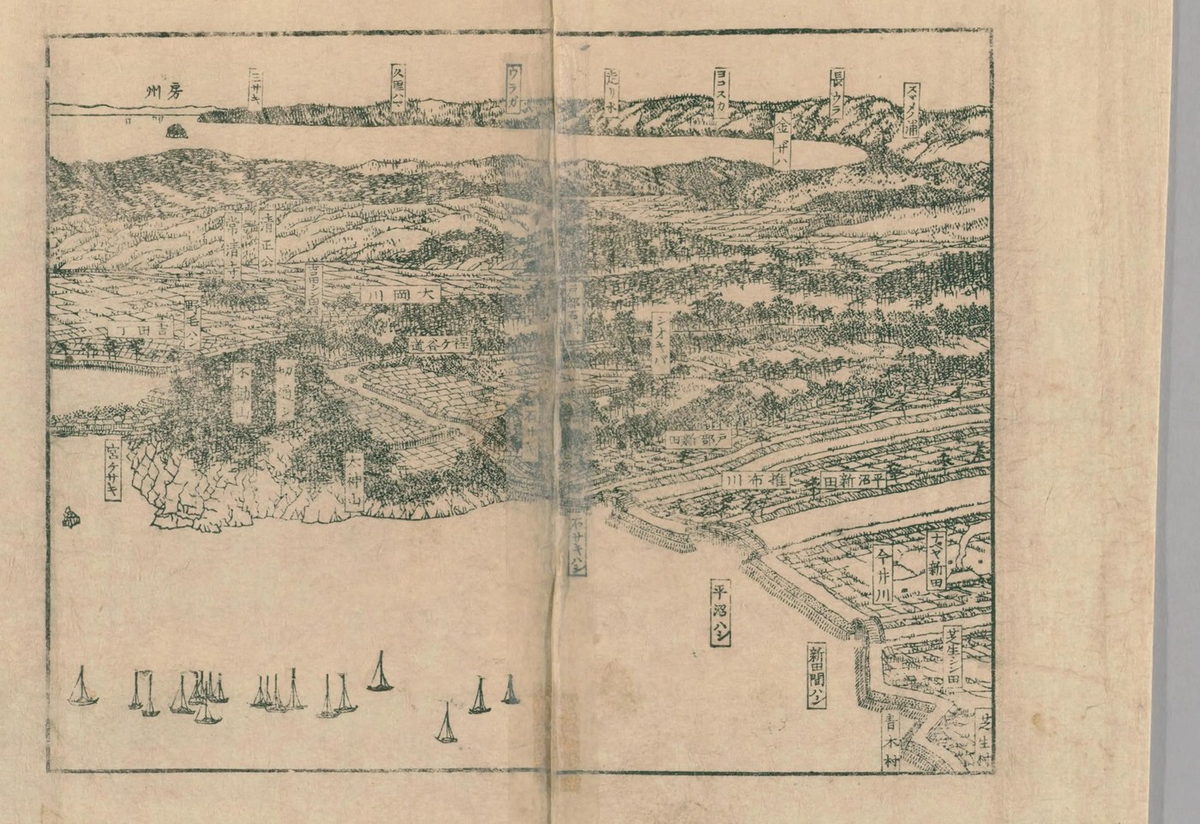
The shipyard, the army training school and the language school were one plan. The language school of the three opened on the sixth day of the third month of 1865, next to the Benten shrine at Yokohama, in what is now Honchō 6-chōme in Naka ward. Its name was the French language school, the Collège Franco-Japonais as the French called it. Three men set it up: Oguri, Kurimoto Joun and Asano Mimasaka-no-kami Ujisuke.
The teachers were French
Institutions for teaching a foreign language existed in the Edo period too: the schools of Dutch learning. A very few taught French as well. The chief of them was the shogunate's Bansho Shirabesho, which took up the study of French in 1860. That body was renamed in turn the Yōsho Shirabesho, the Kaiseijo and the Daigaku Nankō, and became part of the University of Tokyo of today.
What was taught at the Bansho Shirabesho, though, was taught by Japanese. The foremost of them, Murakami Hidetoshi, had the distinction of having learned it all from books on his own; but Sakamoto Fujiyoshi's Oguri Kōzukenosuke no Shōgai points out that there were limits in that, and a great defect in pronunciation in particular.
The French language school at Yokohama broke new ground on one point: its teachers were French. Mermet de Cachon, a French missionary, was invited as its head. The post of assistant went to Charles Buland, the military attaché at the legation, and Henri Veuve, Léon Blanc, Fernand Pousset and Louis Samy were engaged as teachers besides. In scale and in content it overshadowed every language institution before it.
Cachon could be placed at the head of the school because of Kurimoto Joun's connection with him. Kurimoto had been a physician in the shogun's inner attendance, but a trial ride on the warship Kankō Maru angered his superiors, and he was driven out of Edo and served six years at Hakodate. There he met Cachon, a French Jesuit priest. Kurimoto taught him Japanese and learned French in return. Teaching Japanese to a foreigner was new to Kurimoto as well, but the two men took to each other, it is said. After four years of this, Cachon had been called back to France for a time.
A place where the sons of shogunal officials studied
The pupils chosen were sons of shogunal officials. Matakichi (Tadamichi), Oguri's adopted heir, and Teijirō, Kurimoto's eldest son, both studied at this school. Ōtsubo Motoji's Oguri Kōzukenosuke Tadamasa Kakei oyobi Ryaku-nenpu also records that Tadamasa's heir entered the French school. Among the others was Jūrō, son of Ogata Kōan, known for the Tekijuku. The choice of pupils shows an intention beyond teaching a language: to pass the technical connection with France on to the next generation.
Matakichi Tadamichi was taken into the Oguri house as adopted heir from the family of the hatamoto Komai Kai-no-kami. On the third day of the fourth month of 1868 he was made to present himself, with his stewards, at the imperial army's field office at Takasaki, and on the seventh day of the fourth month he was beheaded there. It was the day after Oguri was beheaded on the bed of the Karasu River at the village of Gonda. The other graduates, though, carried the study of French in Meiji Japan. The work of Tanaka Hiroyoshi, who wrote a Japanese–French dictionary; of Mogi Kō, who made the Futsuwa Taiyaku Heigo Jirui, a French–Japanese glossary of military terms; of Oda Nobuyoshi, who compiled a Japanese–French dictionary; and of Tanaka Akira, is still highly regarded.
The school was tied directly to the training of engineers for the Yokosuka ironworks. The rules of the school set up inside the works laid down that a pupil “is admitted only after finishing a school such as the French language school at Yokohama”. Lay the ground in the language at Yokohama, learn shipbuilding at Yokosuka — the two-stage course of training was drawn already when the school opened.
In the three months he was out of office
Around 1865, the year the school opened, the shogunate was deepening its relations with France fast. In the second month of that year the senior councillor Matsumae Izu-no-kami himself directed cavalry drill at Komaba in Edo, and in the fifth month twenty thousand officers and men were drawn up for a review by the shogun Iemochi. The request to the French minister for army instructors was made in writing by this same Matsumae. By Kurimoto's account all this went forward in perfect secrecy, so that “in the world at large, still no one knew of it”.
When he set up this language school Oguri was out of office. And in a bare three months he was back as commissioner of finance, revenue side, because there was no one else who could manage the shogunate's hard-pressed finances. Sakamoto Fujiyoshi, regretting the haste, writes: “Had the return to office come later, this school might now be one of the great private institutions.”
Sources: Sakamoto Fujiyoshi, Oguri Kōzukenosuke no Shōgai (the life of Oguri Kōzukenosuke), Kōdansha, 1987; Abe Dōzan, Kaigun no Senkusha Oguri Kōzukenosuke Seiden (a true life of Oguri Kōzukenosuke, pioneer of the navy), Kaigun Yūshūkai, 1941 (quoting Kurimoto Joun's Hōan Ikō); Ōtsubo Motoji, Oguri Kōzukenosuke Tadamasa Kakei oyobi Ryaku-nenpu (the genealogy and short chronology of Oguri Kōzukenosuke Tadamasa), Oguri Kō Kenshōkai, 1957
→ Training shipbuilders — a school inside the works → Kurimoto Joun