What Oguri brought back from the embassy to the United States was not a shipyard's drawings alone. Raising capital, starting a business and paying the profit out to those who put the money in — the idea of the joint-stock company, in present terms, was brought into Japan by Oguri too.
Two things came of it: the Hyōgo Shōsha, the first joint-stock company in Japan, and the Tsukiji Hotel, the first Western hotel built in earnest by Japanese.
The Hyōgo Shōsha, the first joint-stock company in Japan
In 1867, ahead of the opening of the port of Hyōgo, Oguri proposed to the shogunate the founding of a merchants' association — a “kompenī”. Japanese merchants worked separately and on small capital, so the great foreign houses beat them down one by one and drove them into undercutting one another. This did not end with the profit and loss of the individual merchant: it became a question of the profit and loss of the country. That was his argument.
The proposal was to have some twenty merchants of Osaka put up capital and form an association, with officers and articles, and to let anyone join at a set price per share. With the profits, gas lighting, a post and a telegraph would be set up, and a railway laid between Edo and Yokohama. The plan looked as far ahead as building the country's infrastructure through a joint-stock company.
On the fifth day of the sixth month of 1867 the shogunate summoned twenty wealthy merchants of Osaka to Kyoto and ordered the company formed; an office was opened at Nakanoshima in Osaka and the work began. But with the return of power to the emperor, the defeat at Toba and Fushimi and the dissolution of the shogunate, it was wound up after about half a year, before it could get properly under way.
Standing against control by advances
What Oguri objected to was the foreign merchants' practice of control by advances.
At first they buy Japanese goods high. When the pleased Japanese merchant brings in more, they say the goods are now in surplus, hold back and beat the price down. Once Japanese with little capital have been driven into undercutting one another, the foreigners advance funds and come by degrees to have them at their will. To Western merchants used to colonial rule it was the obvious method.
Scattered small capital cannot get clear of that structure. Hence an association, to gather the capital together. Oguri's proposal came out of that judgment.
What he saw beyond it
The proposal for the Hyōgo Shōsha went as far as what the profits were for: gas lighting, a shoshinkan or post office, a telegraph, and a railway between Edo and Yokohama. The plan looked as far ahead as building the country's infrastructure out of a joint-stock company's profits.
All of these were carried out after 1868 by other hands. Ōkuma Shigenobu's reported remark that the modernization of the Meiji era was little more than a copy of what Oguri Kōzukenosuke had designed points to that correspondence.
The Tsukiji Hotel — a hotel built on joint-stock lines
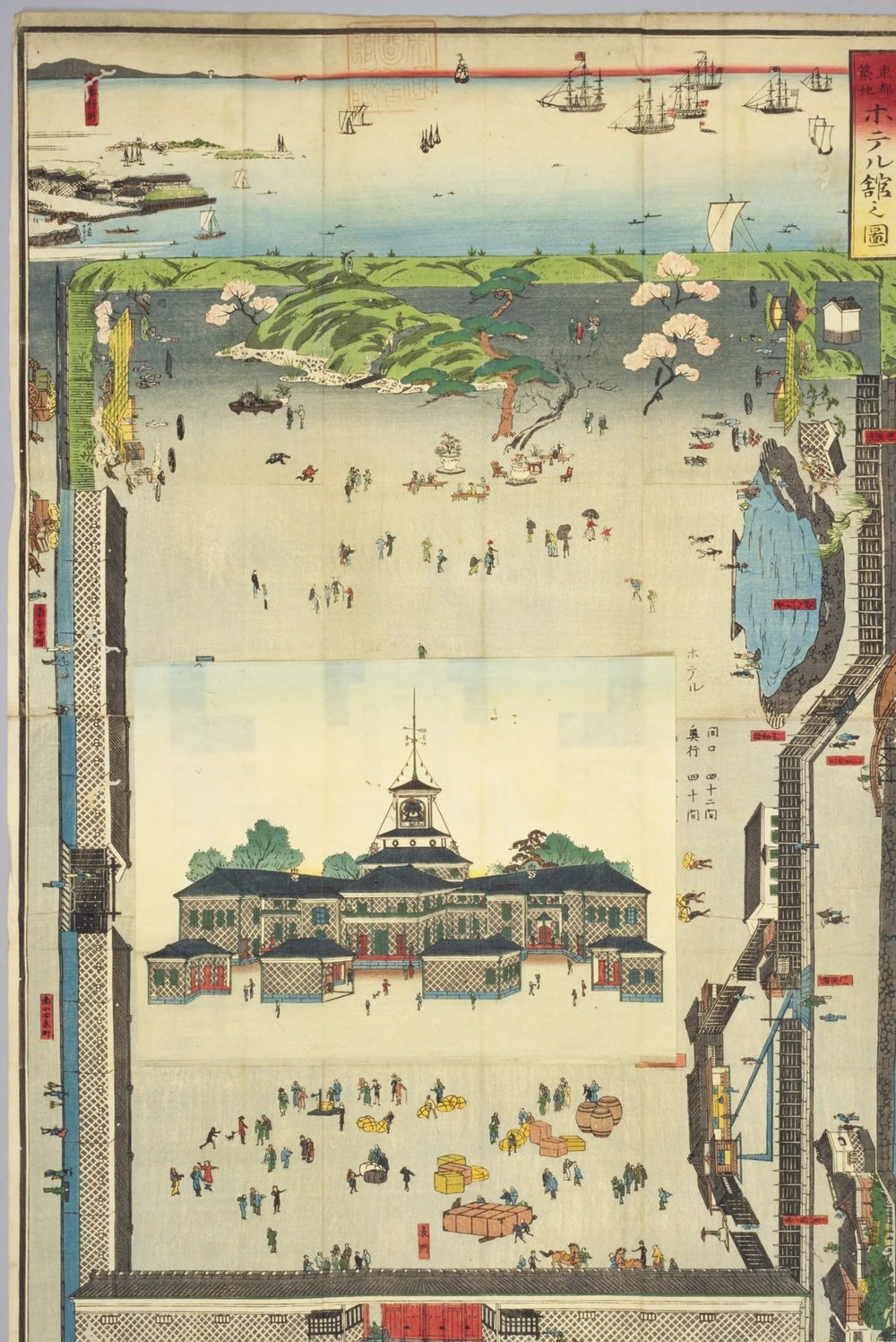
Under the treaties with the five powers, Edo was committed to providing a foreign settlement and lodgings. Pressed by Parkes, the British minister, and with the shogunate's finances in difficulty, Oguri thought of a way to build it with private capital raised in shares. He let it be known privately that the land would be lent free of charge and that whoever built could run the place and take the profit, and the contractor Shimizu Kisuke took it up.
One condition attached: the scale and the contents were to follow the shogunate's instructions. That came from his stays at Willard's Hotel in Washington and the Hotel Metropolitan in New York during the embassy. The building had flush lavatories, showers, a bar and a billiard room, and when it was finished, they say, sightseers crowded to it.
Capital raised, the building put up, the profit paid out. The way the railway company he had seen in Panama was run had been brought over as it stood.
In more detail
Oguri's plans for the economy were not the Hyōgo Shōsha and the Tsukiji Hotel alone. Ten related articles take in the proposal for a centralized exchange office that came to nothing, his connection with Minomura Rizaemon, who held Mitsui up, the first convertible paper money in Japan, and the plans that were never carried out: a joint French-Japanese trading company, the loan negotiations, a newspaper and a powder works.
-
The central bank the shogunate planned, and never had
A centralized exchange office: the commissioners, district governors and intendants in the provinces were to handle bills in gold and silver, and the proceeds to become revenue for the shogunate. The money changers opposed it and it was never set up.
-
How a big man with no letters but an eye for people rose from a casual hand about the Oguri residence to be put in charge of Mitsui's office of shogunal business.
-
The man who saved Mitsui, and how far he rose
In 1866 Minomura Rizaemon led a plan to recover the loans made to the daimyō, and saved Mitsui from the crisis over the shogunate's levy. Oguri's backing stood behind it.
-
The first convertible paper money in Japan, the Edo–Yokohama note
The “Edo–Yokohama note” issued in the eighth month of 1867: the first convertible paper money in Japan, with Mitsui's office of shogunal business handling the issue.
-
The founding of the Hyōgo Shōsha, the first joint-stock company in Japan
The Hyōgo Shōsha in detail: the officers, how investment and dividends worked, and the shock it gave Satsuma and Godai Tomoatsu.
-
Set beside Sakamoto Ryōma's Kaientai
In the same fourth month of 1867, Oguri on the shogunate's side and Sakamoto Ryōma on the side of Tosa and Satsuma were each starting a business on organized capital, in different forms.
-
The joint French-Japanese company that never was
In 1865, before the Hyōgo Shōsha, he put before the shogunate's councillors a plan for a large commercial and shipping company held jointly with France.
-
The six-million-dollar loan that never was
The negotiations with Britain and France for a six-million-dollar foreign loan came to nothing. Katsu Kaishū's reading of it as a scheme to procure arms is set out as well, without taking sides.
-
A newspaper that did not get started
He put a plan before the shogunate's councillors to have Fukuzawa Yukichi publish a newspaper, and it was rejected. Kurimoto Joun is said to have taken up the same line in later years.
-
The powder works at Takinogawa that never was
There is a record that with Takeda Ayasaburō and Sawa Tarōzaemon he planned the first Western-style powder works in Japan, at Takinogawa in Tokyo.